The short version
You can’t control someone else’s drinking, and that isn’t your fault. How you respond can still help both your loved one and you.
Calm and specific conversations, making the most of the times your loved one isn’t drinking, and letting them face the results of their drinking tend to help more than arguing or pressure. Your own safety and support matter along the way, too. When your loved one is ready, treatment can help, and Eleanor can be part of it.
If someone is in danger right now
- Call 911 if anyone is in immediate danger or someone can’t be woken up.
- Call 911 if someone who has been drinking heavily stops and then has a seizure, a fever, severe confusion, hallucinations, or an irregular heartbeat.1 Stopping heavy drinking suddenly can cause withdrawal, which may quickly become life-threatening.1 A health care provider can help someone stop or cut back more safely. If you can, encourage your loved one to talk with one.2 Learn why stopping drinking suddenly can be dangerous.
- Call or text 988, the Suicide & Crisis Lifeline, if someone is in a suicidal or mental health crisis.3 You can also contact 988 if you’re worried about someone else.4
- Aggression or violence is never okay. Your safety, and the safety of any children in your home, comes first. For free, confidential support, call the National Domestic Violence Hotline at 1-800-799-7233 or text START to 88788.5
It isn’t your fault, and you can’t control it
Your loved one’s drinking isn’t your fault, and changing it is their decision. You can’t control it, but how you respond can still make a difference.
You may have already tried pleading, arguing, or hiding bottles, and you may feel guilty, angry, or alone. Those feelings make sense when someone you love is struggling.
Alcohol use disorder (AUD) is a medical condition. A person with AUD finds it hard to stop or control their drinking, even when it’s causing problems with their health, work, or relationships.6 It isn’t a moral failing or a lack of willpower. AUD can be mild, moderate, or severe, and millions of people in the U.S. have it.6
Seeing AUD as a medical condition can help you separate the person you love from the illness. It also means there’s help: no matter how severe AUD seems, treatment can help people recover and stay in recovery.6
A loved one’s drinking can touch everyone close to them. You can read more about how a loved one’s drinking affects the whole family.
How to talk about it
It can help to pick a calm moment, share what you’ve noticed and why you’re worried, and then listen.2
Choose a time and place where you’re both calm and can focus.2 A good time is when your loved one hasn’t been drinking. It’s normal to feel nervous, and you don’t need the perfect words. Keeping the talk short and focused on one change can help.2
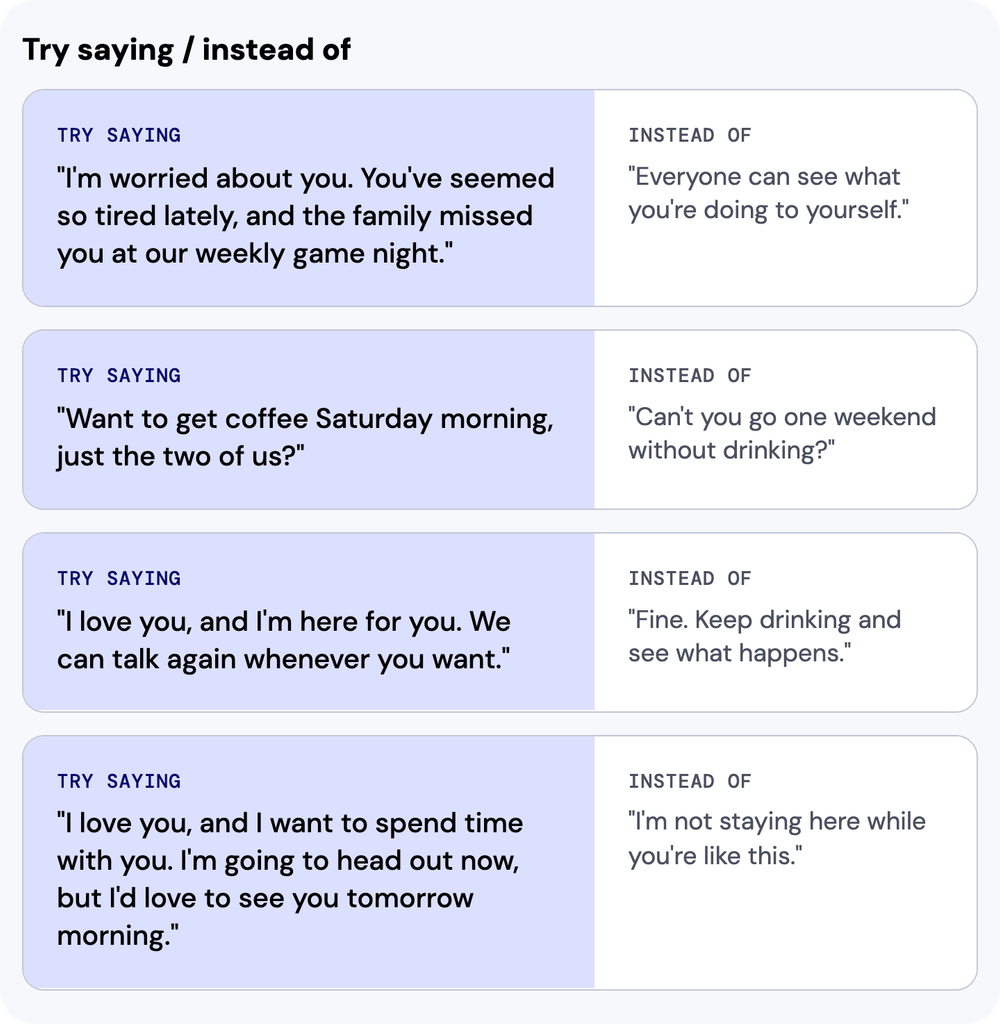
You might start with “I’m worried because…” and name specific things you’ve seen or felt.2 Kind words describe what you’ve seen and how you feel, not what’s wrong with them. For example, “I’m worried because you’ve missed work this week,” not “You’re out of control.”2 You can be kind and still set limits. Being caring doesn’t mean accepting everything.
When you’re scared for someone, it’s natural to want to push harder. But arguing and confronting tend to make people defensive. One study looked at counselors talking with people about their drinking. When counselors were confrontational, people pushed back more, and more pushback was linked to heavier drinking a year later. When counselors listened, people were more open to change.7
If you’d like to suggest a next step, a small one can feel easier for both of you, such as doing something together that doesn’t involve drinking.2 If the conversation isn’t going well, it’s OK to take a break and give them space.2 Taking care of yourself is part of helping, too.2
What tends to help, and what tends to backfire
Many of the ideas in this section come from Community Reinforcement and Family Training (CRAFT), an approach that teaches family members skills to encourage change without pressuring the person who drinks.8 In research, CRAFT helped more families get a loved one into treatment than a support-group approach or a confrontational intervention.9,10 One way to learn CRAFT-based skills is We The Village, an online program.
Before changing any routines, it can help to think about how your loved one might react. If you’re worried about how they’ll respond, your safety comes first, and a counselor can help you talk through the situation before you try these steps.8,9
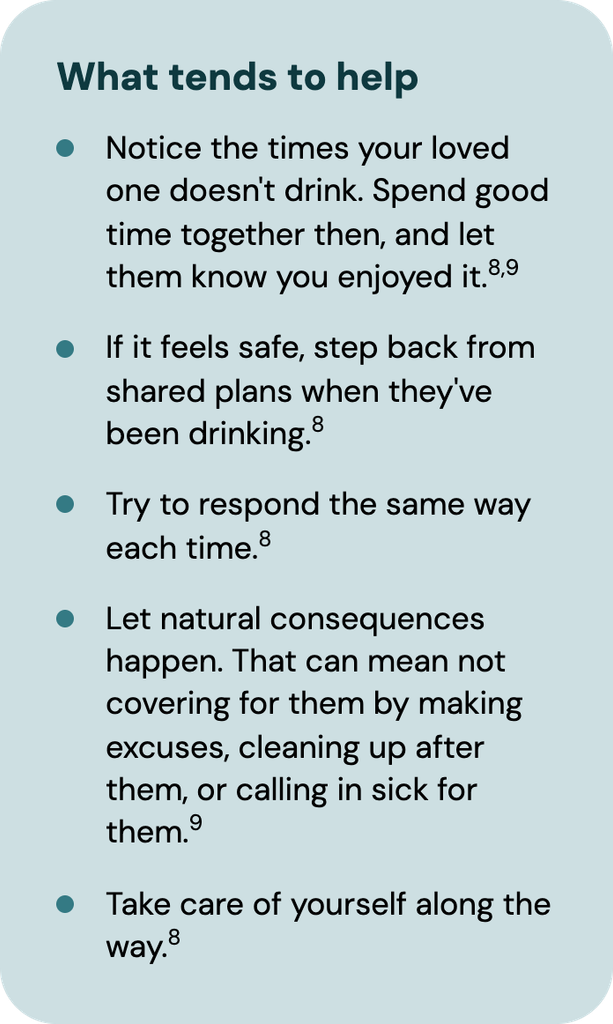
CRAFT focuses on encouraging the times your loved one doesn’t drink, rather than on penalties.9 You can start some of these steps at home, at your own pace, and a counselor or a program like We The Village can help.
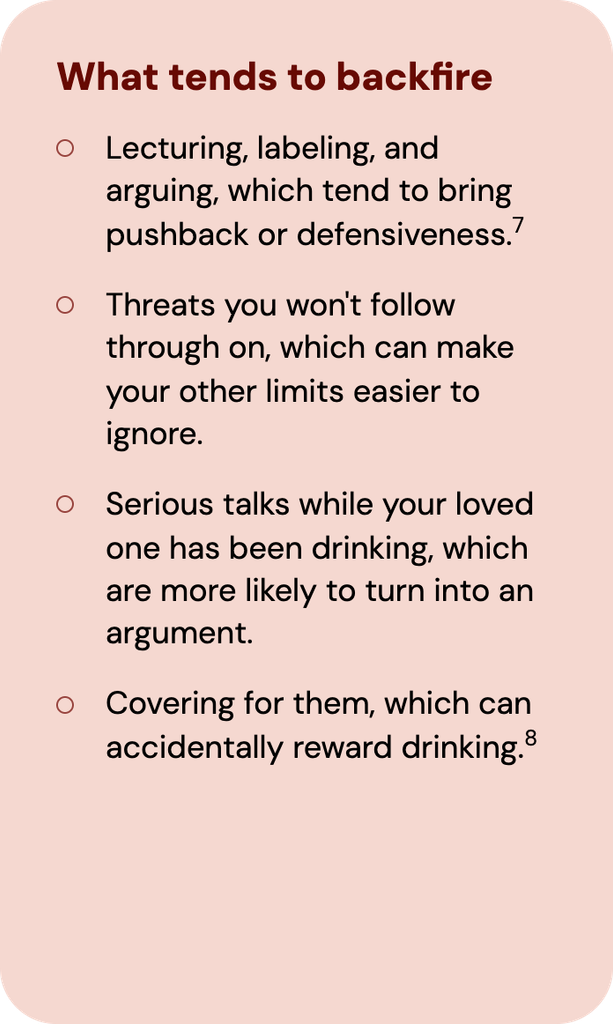
If some of these sound familiar, that makes sense. They often come from love and worry. Small changes in how you respond can still help, starting with your next conversation.
If they say no
Hearing no is a common part of this, even though it can be hard. Many people aren’t ready to seek treatment at first.10 You can keep the door open, keep making the most of the good times, and keep looking after yourself. For more ideas, read what to do when someone you love isn’t ready for treatment.
If it’s your partner
When the person who drinks is your partner, the same calm approach can help, and so can protecting your own safety and routines.
Protecting time together that doesn’t involve alcohol can help, too.8 CRAFT has helped partners, as well as parents and siblings.8
It can also help to decide on boundaries and keep them, around things like money, driving, and your home. For example, you might decide not to give money that could go toward drinking.
If you have children, their needs matter here too. You can read about how to talk with your children about a parent’s drinking.
Alcohol and other substance use disorders are often linked with violence between partners.8 If you feel unsafe, put your safety first. You can call the National Domestic Violence Hotline at 1-800-799-7233 or text START to 88788. It’s free, confidential, and open 24/7.5 If you’re in immediate danger, call 911.
Whether to stay in the relationship is a personal decision, and only you can make it.
Supporting someone once they’re in treatment
The day-to-day choices in recovery are your loved one’s to make, but your encouragement can help. You can show support in simple ways: notice the effort they’re making, ask what would help, celebrate their progress, and tell them you’re proud of them.
Treatment can look different from person to person. Outpatient care can include office or telehealth visits for counseling, medication support, or both.11 Some people also take medications approved for alcohol use disorder as part of their care.
Recovery often has ups and downs. Many people with AUD do recover, and setbacks can happen among people in treatment.2,6 If your loved one returns to drinking, it can feel discouraging for both of you. It’s a temporary setback, not a failure, and a reason to reconnect with care.11 You can read more about how a return to drinking is part of many people’s recovery.
Taking care of yourself
Your own well-being matters, no matter what your loved one decides.2
In studies of family approaches, family members’ own well-being improved9,10, even when their loved one didn’t start treatment.8
Caring about someone who drinks too much can be exhausting, and you deserve support, too. It can help to lean on friends, family, and other people you trust.2 Support groups for families, such as Al-Anon and SMART Recovery Family & Friends, are another option. Eleanor’s page on support for family members is a good place to start.
How Eleanor Health can help
When your loved one is ready, we’re here to be a first point of contact.
Treatment with behavioral therapies, support groups, medications, or a combination can help people with AUD recover.6 At Eleanor Health, we offer outpatient, virtual treatment for alcohol use disorder, combining therapy, medication, and support from our Community Recovery Partners. These team members draw on their own lived experience with recovery to offer encouragement and practical guidance. We accept most insurance, and availability varies by location.
Our clinicians can assess, help determine the right level of care, connect a higher level of care when it’s needed, and stay part of the care team. Stopping or sharply cutting back on heavy drinking can be dangerous,1 and a health care provider can help someone stop or cut back more safely.
Family members and friends can reach out to us to refer someone they care about, and you can share Eleanor with someone you care about. We can’t share someone’s health information without their permission, so your loved one will usually take the first step themselves. If your loved one signs a release of information naming you, our care team can talk with you about their care.
If your loved one is in care with Eleanor, we can often support you too, through family therapy and coaching from our Community Recovery Partners.
If your loved one returns to drinking, their care with us continues. A setback doesn’t end their care.
Eleanor isn’t a crisis service. In an emergency, call 911. In a suicidal or mental health crisis, call or text 988.
You can find support for yourself now, whatever your loved one decides. When they’re ready, the first step is a conversation about care that can continue over time.
Frequently asked questions
What should I not say to someone who drinks too much?
It helps to leave out labels and blame.2,7 It also helps to skip threats you won’t carry out, and to save serious talks for times your loved one hasn’t been drinking. Talking about what you miss can help more than listing everything that’s gone wrong. For example: “I miss cooking dinner together.”
How do I talk to a friend about their drinking?
Choose a calm moment, tell your friend what you’ve noticed, and offer to help.2 You might encourage them to get a checkup with their doctor, where they can talk about their drinking with a professional they trust.2 Family approaches have included close friends, too. You can let your friend know you’ll keep what they share private, unless you’re worried about their safety.
Can I make someone stop drinking?
That choice is theirs, but you can still make a difference. Calm approaches that don’t pressure your loved one can help.8 Stopping heavy drinking suddenly can be dangerous.1 A health care provider can help someone stop or cut back more safely. For more, read what to do when someone you love isn’t ready for treatment.
How can I help my adult child who drinks too much?
The same approach can help: calm conversations, making the most of the good times, and not covering for them. CRAFT has helped parents and their children.8 You may also decide on limits around money and drinking in your home. Those limits are yours to set, and you can set them with love.
How do I support someone who’s in recovery from alcohol use disorder?
Making plans together that don’t involve drinking can help.2 If there’s a setback, you can encourage your loved one to reconnect with care and keep noticing the effort they’re making.
Should I stay with a partner who drinks too much?
That’s a personal decision, and only you can make it. Your safety comes first: if you’re in danger, call 911. You can also call the National Domestic Violence Hotline at 1-800-799-7233 or text START to 88788.5 Support for you is available, whatever you decide.
References
- Alcohol withdrawal. MedlinePlus Medical Encyclopedia. National Library of Medicine. Reviewed January 1, 2025. Accessed October 5, 2026. https://medlineplus.gov/ency/article/000764.htm
- Office of Disease Prevention and Health Promotion. Alcohol use: conversation starters. MyHealthfinder. Last reviewed March 2025. Last updated May 1, 2025. Accessed October 5, 2026. https://odphp.health.gov/myhealthfinder/healthy-living/mental-health-and-relationships/alcohol-use-conversation-starters
- Substance Abuse and Mental Health Services Administration. 988 Suicide & Crisis Lifeline. Accessed October 5, 2026. https://www.samhsa.gov/mental-health/988
- 988 Suicide & Crisis Lifeline. Help someone else. Accessed October 5, 2026. https://988lifeline.org/help-someone-else/
- National Domestic Violence Hotline. Accessed October 28, 2026. https://www.thehotline.org/
- National Institute on Alcohol Abuse and Alcoholism. Understanding alcohol use disorder. Updated January 2025. Accessed October 5, 2026. https://www.niaaa.nih.gov/publications/brochures-and-fact-sheets/understanding-alcohol-use-disorder
- Miller WR, Benefield RG, Tonigan JS. Enhancing motivation for change in problem drinking: a controlled comparison of two therapist styles. J Consult Clin Psychol. 1993;61(3):455-461. doi:10.1037//0022-006x.61.3.455
- Meyers RJ, Roozen HG, Smith JE. The community reinforcement approach: an update of the evidence. Alcohol Res Health. 2011;33(4):380-388. https://pmc.ncbi.nlm.nih.gov/articles/PMC3860533/
- Miller WR, Meyers RJ, Tonigan JS. Engaging the unmotivated in treatment for alcohol problems: a comparison of three strategies for intervention through family members. J Consult Clin Psychol. 1999;67(5):688-697. doi:10.1037//0022-006x.67.5.688
- Roozen HG, de Waart R, van der Kroft P. Community reinforcement and family training: an effective option to engage treatment-resistant substance-abusing individuals in treatment. Addiction. 2010;105(10):1729-1738. doi:10.1111/j.1360-0443.2010.03016.x
- National Institute on Alcohol Abuse and Alcoholism. Treatment for alcohol problems: finding and getting help. Updated February 2025. Accessed October 5, 2026. https://www.niaaa.nih.gov/publications/brochures-and-fact-sheets/treatment-alcohol-problems-finding-and-getting-help