The short version
You can’t make someone ready for treatment, and that’s not a reflection on you. What you do still matters, and can help your loved one and yourself.
Calm approaches that avoid blame and pressure, especially a family method called Community Reinforcement and Family Training (CRAFT), have helped more families get a loved one into treatment than confrontational interventions. Along the way, look after your own safety and well-being, and have a plan ready for the moment your loved one says yes.
If someone is in danger right now
- Call 911 if someone may be overdosing, can’t be woken up, or anyone is in immediate danger.
- Call or text 988, the Suicide & Crisis Lifeline, if someone is in a suicidal or mental health crisis.1 You can also contact 988 if you’re worried about someone else.2
- If you think someone is having an opioid overdose, naloxone can reverse it.3 Learn how naloxone works.
- Stopping heavy drinking suddenly can cause withdrawal, which may quickly become life-threatening.4 A health care provider can help someone stop or cut back more safely. If you can, encourage your loved one to talk with one.5 Learn why stopping drinking suddenly can be dangerous.
- If you’re not safe at home, put your safety first. For free, confidential support, call the National Domestic Violence Hotline at 1-800-799-7233 or text START to 88788.6 If you’re in immediate danger, call 911.
Why someone you love might not be ready
Hearing no from someone you love can hurt. Many people with a substance use disorder may not want treatment, at least at first.7 A substance use disorder is a medical condition in which drinking or drug use becomes hard to control, even when it’s causing harm. Resistance to treatment often strains relationships with the people closest to them. That strain may be part of what brought you here.
A no to treatment often comes from mixed feelings about change. Part of your loved one may want things to be different, while another part isn’t ready yet. Feeling pulled in two directions like this is normal for anyone weighing a big change.8
Fear and shame can also make it harder to say yes. You can read more about how guilt, shame, and stigma can get in the way.
Being ready to get help, or not, doesn’t stay the same. It can change over time.8
What you can and can’t control
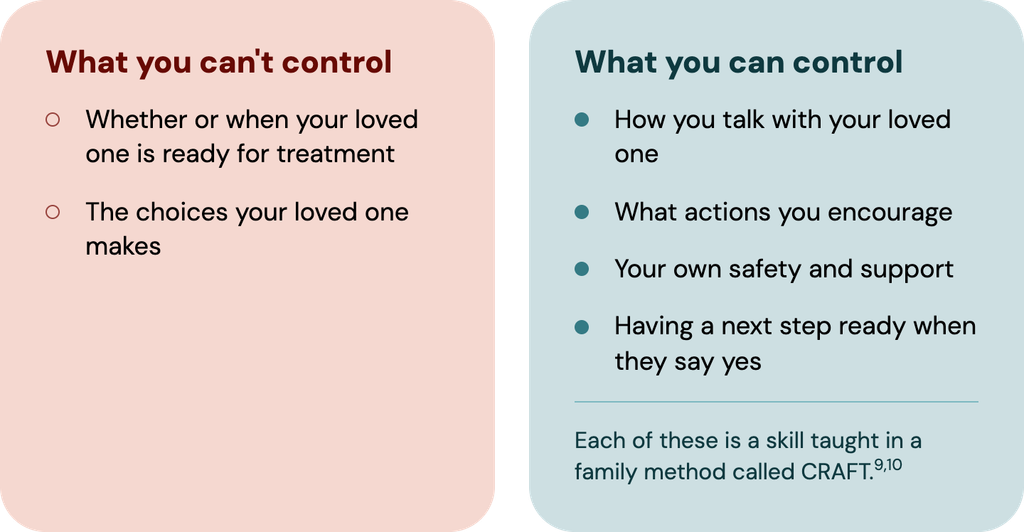
The decision to start treatment belongs to your loved one, so you aren’t responsible for whether or when they say yes. You still have influence.7,9
What you can control is how you talk with them, what actions you encourage, how you protect your own safety and well-being, and how ready you are with a next step when they say yes. Each of these is a skill taught in a family method called CRAFT.9,10
CRAFT: an evidence-based approach for families
Community Reinforcement and Family Training (CRAFT) is an evidence-based approach that teaches family members skills to help a loved one move toward treatment. It helps you encourage your loved one without pressuring them.9,10 You can practice some of these skills at home, and a counselor or a program like We The Village can help.
CRAFT starts with safety. Counselors talk through the risk of violence before a family changes any routines.10 If violence is a concern in your home, your safety comes first, so learn CRAFT with a trained counselor rather than on your own.
CRAFT teaches you to:
- Talk with your loved one in positive, encouraging ways.10
- Spend time together when your loved one isn’t drinking or using, and step back from plans when they are.10 Doing this consistently matters.10
- Focus on rewarding the good times rather than punishing the hard ones.9
- Tell the difference between supporting recovery and enabling, which means accidentally rewarding drinking or drug use.10
- Make room for your own life and happiness, whatever your loved one decides.10
In research, CRAFT helped more families get a loved one into treatment than either a support-group approach or a confrontational intervention.7,9 It has helped partners, parents and children, and siblings,10 and families whose loved one used alcohol or other drugs.7,10
Getting support while you learn CRAFT, such as sessions with a trained counselor, has been linked to better results than working through the process on your own.11 One option is We The Village, an online program built on CRAFT that Eleanor Health has worked with.
How to talk about it without pushing them away
Calm, kind conversations help keep the door open, even after a no. In CRAFT, positive communication is key.10 For broader guidance on helping with drinking, see how to help someone with a drinking problem.
Choose a calm time to talk, rather than waiting until something goes wrong.9 A good time is usually when your loved one hasn’t been drinking or using.
When you talk, these steps can help:12
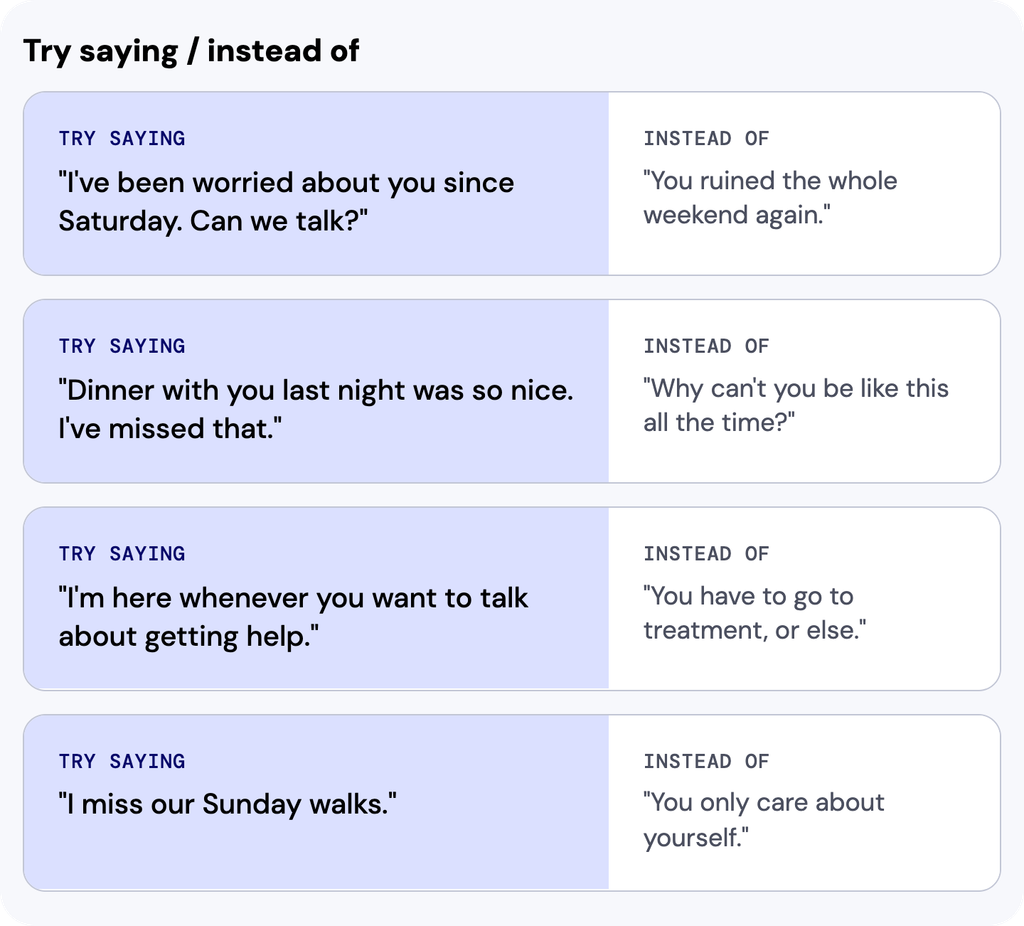
- Say what you’ve noticed and how it affects you, without blame or shame.
- Tell them you hope they’ll get help.
- Notice and thank them for any positive change.
Starting with “I” keeps the focus on what you’ve seen and felt, as in “I’ve been worried about you.” Skip labels, since they can bring up shame and lead to an argument.8 Listen more than you talk. Aim for connection with your loved one.
Confrontation tends to make people dig in. In a study of counselors helping people with their drinking, a confrontational style led to more pushback, such as arguing and interrupting. That pushback was linked to heavier drinking a year later.13
Taking care of yourself while you wait
Caring about someone who isn’t ready for help can wear you down. Your well-being matters. In research, family members who used a family approach felt better in body and mind.7,9 That was true whichever approach they used7,9, and whether or not their loved one started treatment.10 Making room for your own life is part of CRAFT, too.10
Looking after yourself helps you stay steady for the long run, both for you and for the person you love. Support groups for families are another option, and Eleanor’s page on support for family members is a good place to start. You can also read about how a loved one’s substance use affects the whole family.
What about an intervention?
A formal intervention is a planned meeting where family and friends, often guided by a professional, confront the person together, in a caring way, about their drinking or drug use and ask them to start treatment.7,9
One well-known study compared an intervention with CRAFT for families worried about a loved one’s drinking. Overall, more loved ones started treatment when their families used CRAFT. With interventions, results were mixed: most families who prepared for one decided not to hold it, but among those who did, most saw their loved one start treatment.9
If you prepared for an intervention and then stepped back, most families in that study made the same choice. Stepping back isn’t a sign that those families cared less. The researchers saw it as a reason to offer families a different approach.9
Eleanor doesn’t coordinate formal interventions. Be ready for the moment they say yes
Readiness can change, so it helps to have a next step ready before the moment comes.8,9 When treatment is easy to start, people may be more likely to begin.11
A few things to know ahead of time:
- Outpatient care is one option. For alcohol, outpatient care can include office or telehealth visits for counseling, medication support, or both.14
- Check insurance ahead of time. Eleanor offers care with most insurance accepted.
- Eleanor can help when a family member or friend reaches out to refer someone they care about. You can share Eleanor with someone you care about.
- Eleanor can’t share a person’s health information without their permission, so your loved one will usually take the first step themselves. If your loved one signs a release of information naming you, our care team can talk with you about their care.
Whatever approach you choose, whether it’s CRAFT, a formal intervention, or another way of encouraging treatment, lead with compassion. Confrontation, blame, and pressure can make someone less willing to listen. Focus on expressing your concern, listening without judgment, and helping your loved one feel supported rather than cornered.
How Eleanor Health can help
When your loved one is ready, we can be a first point of contact. In an emergency, call 911. In a suicidal or mental health crisis, call or text 988. Eleanor isn’t a crisis service. Once the immediate danger has passed, your loved one can reach out to us to start care.
Our clinicians can assess your loved one’s needs and help determine the right level of care. If they need more support than virtual outpatient treatment can provide, we may recommend medically supervised withdrawal (detox), an intensive outpatient program, residential treatment, or care in an emergency room when needed. We’ll start by listening to what’s been going on and helping your loved one figure out what kind of support makes sense.
At Eleanor Health, we offer outpatient, virtual treatment for substance use disorders, combining medication, therapy, and support from our Community Recovery Partners. These team members draw on their own lived experience with recovery to offer encouragement and practical guidance. We accept most insurance, and availability varies by location.
If your loved one has a setback, such as a return to drinking or drug use, we won’t turn them away or end their care. Instead, our care team will work with them to understand what may have contributed to the setback, identify what support they need, and help them take the next steps toward recovery.
If your loved one is in care with Eleanor, we can often support you too, through family therapy and coaching from our Community Recovery Partners.
You can find support for family members now, whatever your loved one decides. When they’re ready, the first step is a conversation about care that can continue over time.
Frequently asked questions
Can I make someone go to treatment?
You can’t make someone ready for treatment. Laws about court-ordered treatment vary by state, so questions about whether treatment can be legally required are best taken to a qualified attorney. What you can change is how you respond, using approaches like CRAFT that work gently and don’t pressure your loved one.10 If anyone is in immediate danger, call 911.
What should I say to encourage someone to get help?
Keep it short, kind, and about how you feel. For example: “I love you, and I’m worried. Whenever you want help finding care, I’ll help you look.” Let them know you hope they’ll get help,12 and pick a calm moment rather than waiting for things to go wrong.9
Do interventions work?
Sometimes. In one well-known study, most families who held an intervention saw their loved one start treatment, but most families who prepared for one decided not to hold it. CRAFT helped more people start treatment overall.9 Eleanor doesn’t coordinate interventions.
How can I support someone without enabling them?
Enabling means accidentally rewarding drinking or drug use.10 Caring people can slip into it without meaning to.12 Supporting recovery means putting your time and attention into the times your loved one isn’t drinking or using.10 For example, you might suggest a walk or a meal out on a day they’re not drinking or using, and skip the plan on a day they are.
What if they say no again?
A no today can change later.8 Keep the door open, keep looking after yourself, and lean on support for family members. The skills you practice can help your own life, whatever your loved one decides.10
What happens if my loved one decides to get help with Eleanor?
Eleanor provides outpatient, virtual treatment for substance use disorders, combining medication, therapy, and Community Recovery Partner support. Most insurance is accepted, and availability varies by location. You can reach out to refer someone you care about. Because of privacy, your loved one will usually take the first step themselves, and that step starts a conversation about care that can continue over time.
References
- Substance Abuse and Mental Health Services Administration. 988 Suicide & Crisis Lifeline. Accessed October 5, 2026. https://www.samhsa.gov/mental-health/988
- 988 Suicide & Crisis Lifeline. Help someone else. Accessed October 5, 2026. https://988lifeline.org/help-someone-else/
- Centers for Disease Control and Prevention. Lifesaving naloxone. Last reviewed June 11, 2025. Accessed October 5, 2026. https://www.cdc.gov/stop-overdose/caring/index.html
- Alcohol withdrawal. MedlinePlus Medical Encyclopedia. National Library of Medicine. Reviewed January 1, 2025. Accessed October 5, 2026. https://medlineplus.gov/ency/article/000764.htm
- Office of Disease Prevention and Health Promotion. Alcohol use: conversation starters. MyHealthfinder. Last reviewed March 2025. Last updated May 1, 2025. Accessed October 28, 2026. https://odphp.health.gov/myhealthfinder/healthy-living/mental-health-and-relationships/alcohol-use-conversation-starters
- National Domestic Violence Hotline. Accessed October 28, 2026. https://www.thehotline.org/
- Roozen HG, de Waart R, van der Kroft P. Community reinforcement and family training: an effective option to engage treatment-resistant substance-abusing individuals in treatment. Addiction. 2010;105(10):1729-1738. doi:10.1111/j.1360-0443.2010.03016.x
- Substance Abuse and Mental Health Services Administration. Enhancing Motivation for Change in Substance Use Disorder Treatment. Treatment Improvement Protocol (TIP) Series 35. Updated 2019. Accessed October 5, 2026. https://www.ncbi.nlm.nih.gov/books/NBK571071/
- Miller WR, Meyers RJ, Tonigan JS. Engaging the unmotivated in treatment for alcohol problems: a comparison of three strategies for intervention through family members. J Consult Clin Psychol. 1999;67(5):688-697. doi:10.1037//0022-006x.67.5.688
- Meyers RJ, Roozen HG, Smith JE. The community reinforcement approach: an update of the evidence. Alcohol Res Health. 2011;33(4):380-388. https://pmc.ncbi.nlm.nih.gov/articles/PMC3860533/
- Archer M, Harwood H, Stevelink S, Rafferty L, Greenberg N. Community reinforcement and family training and rates of treatment entry: a systematic review. Addiction. 2020;115(6):1024-1037. doi:10.1111/add.14901
- Substance Abuse and Mental Health Services Administration. Substance Use Disorder Treatment and Family Therapy. Treatment Improvement Protocol (TIP) Series 39. Updated 2020. PMID 34106562. Accessed October 5, 2026. https://www.ncbi.nlm.nih.gov/books/NBK571080/
- Miller WR, Benefield RG, Tonigan JS. Enhancing motivation for change in problem drinking: a controlled comparison of two therapist styles. J Consult Clin Psychol. 1993;61(3):455-461. doi:10.1037//0022-006x.61.3.455
- National Institute on Alcohol Abuse and Alcoholism. Treatment for alcohol problems: finding and getting help. Updated February 2025. Accessed October 5, 2026. https://www.niaaa.nih.gov/publications/brochures-and-fact-sheets/treatment-alcohol-problems-finding-and-getting-help