The short version
- Wet brain is a common, nonmedical name for Wernicke-Korsakoff syndrome, a brain condition caused by a lack of thiamine (vitamin B1). It’s most often linked to heavy drinking.
- Its first stage, Wernicke encephalopathy, is a medical emergency, and getting treatment quickly makes a difference.
- Its later stage, Korsakoff syndrome, can leave lasting memory problems.
If you’re worried this is happening now
If someone who drinks heavily is suddenly confused, very unsteady on their feet, having new eye or vision problems, or hard to wake, call 911 or go to the emergency room now.1,2 You don’t need to see every sign to get help.3 Tell the care team about the person’s drinking, since doctors diagnose it partly from a person’s history.1
What is Wernicke-Korsakoff syndrome?
Wernicke-Korsakoff syndrome is a brain condition caused by a lack of thiamine, also called vitamin B1.2 Wet brain is a common, nonmedical name for the condition.
Thiamine is a nutrient the brain needs to work. The body can’t make it, so it has to come from food.4 In Wernicke-Korsakoff syndrome, damage can affect areas of the brain that support memory, movement, vision, sleep, and motivation.1
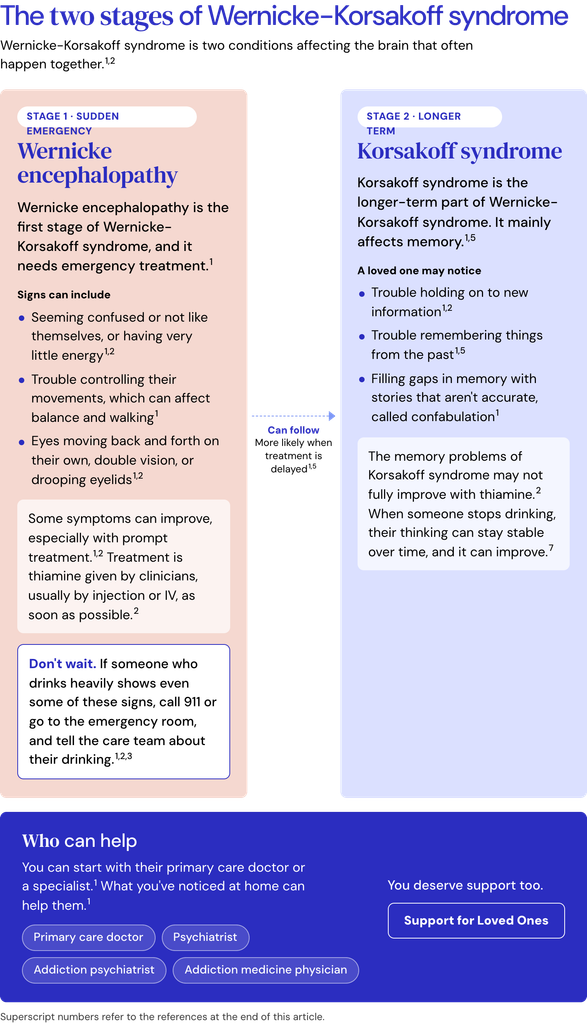
Wernicke-Korsakoff syndrome is two conditions affecting the brain that often happen together.1,2 Wernicke encephalopathy happens first and is a medical emergency.1 Encephalopathy is a medical word for a problem with how the brain is working. Symptoms can include confusion, trouble with balance or walking, and changes in eye movement or vision. Korsakoff syndrome can happen after this and mainly affects memory.2,5
Heavy drinking is the most common cause of Wernicke-Korsakoff syndrome in the United States.1,3 Other conditions that lower thiamine, such as severe vomiting or some weight-loss surgeries, can also cause it, though far less often.1,2
How heavy drinking leads to it
Heavy drinking can lower the body’s thiamine in three ways. Someone may get less thiamine from what they eat. Their body may absorb less of it, partly because poor nutrition makes it harder for the gut to take in thiamine from food. And their cells may use it less effectively.1,4
Low thiamine doesn’t affect everyone the same way.4 Two people who drink similar amounts may not face the same risk, which is one reason a clinician looks at the whole person and their health.
Wernicke encephalopathy: the emergency stage
Wernicke encephalopathy is the first stage of Wernicke-Korsakoff syndrome, and it needs emergency treatment.1
Someone with Wernicke encephalopathy may seem confused or not like themselves. They may have very little energy.1,2 They may have coordination problems, meaning trouble controlling their movements, which can affect their balance and walking.1 Their eyes may move back and forth on their own, or they may have double vision or drooping eyelids.1,2
If someone who drinks heavily shows even some of these signs, call 911 or go to the emergency room rather than waiting to see if they improve, and tell the care team about their drinking.1,2,3
Wernicke encephalopathy is preventable and treatable.6 It can often go unrecognized, partly because many people don’t show every sign of the condition.3,6 Clinicians use specific signs to recognize it, and when they suspect it, they start treatment right away.3,6
Treatment is thiamine given by clinicians, usually by injection or IV, as soon as possible.2 Some people need to stay in the hospital early on.2 Clinicians may also treat other symptoms at the same time.1
Korsakoff syndrome: the longer-term stage
Korsakoff syndrome is the longer-term part of Wernicke-Korsakoff syndrome. It mainly affects memory.1,5 It can develop as the symptoms of Wernicke encephalopathy lessen or go away.2 This is more likely when treatment didn’t come quickly.1,5
Someone with Korsakoff syndrome may have trouble holding on to new information.1,2 They may also have trouble remembering things from the past.1,5 For some people, memory loss can be severe.2 It can affect many parts of daily life.5
They may fill gaps in their memory with stories that aren’t accurate. This is called confabulation.1 The person believes these stories. The stories come up without the person meaning to, so they aren’t lies.5 Knowing that confabulation is a symptom can make hard conversations a little less painful.
A family member or loved one may notice other changes, too. The person may repeat the same words or actions.1 They may have trouble planning, organizing, and making decisions.1,5 They may seem to have little motivation, or not care about things.1,5 Some people see or hear things that aren’t there.1,2
Can it be reversed?
Some symptoms can improve, especially with prompt treatment.1,2
Prompt thiamine treatment can help with confusion, and it can reverse problems with vision, eye movement, and coordination.1,2 Other symptoms may take longer to improve, and some may not fully go away.1
When someone stops drinking, their thinking can stay stable over time, and it can improve.7 Stopping drinking also helps prevent more damage.1,2 The memory problems of Korsakoff syndrome may not fully improve with thiamine.2
Wernicke-Korsakoff syndrome is one condition related to heavy drinking. It’s different from the general brain changes heavy drinking can cause, and research shows the brain can at least partly recover after someone stops.7 Read more about how the brain can recover after someone stops drinking.
Is it the same as alcohol-related dementia?
Not exactly. They’re closely related, and many experts consider them different conditions.7 Both fall under a wider medical term, alcohol-related brain damage, which covers the ways heavy drinking can affect thinking and memory.1 A clinician can tell them apart and treat the specific condition.
Treatment and ongoing care
Treatment for Wernicke-Korsakoff syndrome starts with thiamine given by clinicians, and ongoing care focuses on nutrition, specific symptoms, and support for memory.1
For Wernicke encephalopathy, treatment is urgent and often happens in the hospital.2 Thiamine is also a standard part of medical care during alcohol withdrawal, given and managed by clinicians.8 Alcohol use disorder is when drinking has become hard to control, even though it’s causing harm.
For Korsakoff syndrome, care includes good nutrition, fluids, and treatment for specific symptoms.1 Memory rehabilitation, structured practice that makes daily memory problems easier to manage, can help lessen symptoms.1,5 Some people with severe symptoms need residential care, where they live with ongoing support.1
Stopping drinking is part of care at every stage. Plan it with a clinician, because stopping suddenly after a long period of heavy drinking can be dangerous.1 Learn more about why stopping suddenly can be dangerous.
What to expect over time
With treatment, the symptoms of Wernicke-Korsakoff syndrome can be controlled, and the condition can be slowed or stopped.2 Without treatment, it can get steadily worse and may be life-threatening.2
How things go is different for each person, and it depends a lot on how early treatment is started. Delayed treatment makes it more likely that Wernicke encephalopathy leads to Korsakoff syndrome.1,5 The care team is the best place to ask what to expect for you or the person you love.
Caring for someone with Wernicke-Korsakoff syndrome
Caring for someone with Wernicke-Korsakoff syndrome is hard, and you don’t have to figure it out alone. It can be frightening to see someone you love confused, and exhausting to answer the same question again and again. You may feel grief for the person they were while also worrying about their future.
Memory gaps and inaccurate stories are symptoms of Korsakoff syndrome, not choices.5 The person may also not realize anything is wrong.5 That can explain why they may push back when you offer help.
You can start with their primary care doctor or a specialist, such as a psychiatrist, addiction psychiatrist, or addiction medicine physician.1 Clinicians look at the person’s drinking and health history along with changes in memory, thinking, and movement, so what you’ve noticed at home can help them.1 Possible complications include falls and difficulty with everyday social interaction.2
You deserve support too. Eleanor offers support for family members, not only for the person who drinks. You can also read about how families can get help and how a loved one’s drinking affects the whole family.
If you’re worried about yourself
Wernicke encephalopathy, the first stage of Wernicke-Korsakoff syndrome, is preventable, and it’s treatable when it’s caught early.6 If you drink heavily, stopping helps prevent more damage to your brain, and drinking less lowers your risk of Wernicke-Korsakoff syndrome.1,2 A clinician can help you do that safely.
How Eleanor Health can help
If someone has signs of Wernicke encephalopathy, call 911 or go to the emergency room first.
For everything else, Eleanor can be a first call, for you and for the person you love. Eleanor clinicians can assess, help determine the right level of care, connect a higher level of care when it’s needed, and stay part of the care team. We’ll start by listening to what’s been going on and helping you figure out what kind of support makes sense.
At Eleanor Health, we offer treatment for alcohol use disorder, including therapy and peer support from our Community Recovery Partners. Care happens through telehealth, which means video or phone visits from home. We also support families. We offer care with most insurance accepted, and availability varies by location.
A return to drinking doesn’t end care with Eleanor. We don’t discharge members for a setback. These moments can be part of many people’s recovery, and they aren’t a reason to stop treatment.
Frequently asked questions
What are the first signs of wet brain?
The first signs of Wernicke-Korsakoff syndrome can include confusion, trouble with balance and coordination, eye or vision changes, and being unusually drowsy or hard to wake.1,2 Many people don’t have every sign.3 Any one of these signs in someone who drinks heavily means it’s time for emergency care: call 911 or go to the emergency room.2
Does wet brain ever go away?
With prompt treatment, some symptoms of Wernicke encephalopathy can improve, and treatment can slow or stop Wernicke-Korsakoff syndrome.1,2 Memory problems from Korsakoff syndrome can last.2 Even so, thinking can stay stable, and can even improve, once drinking stops.7 General brain changes from heavy drinking are different, and they can improve after drinking stops; read about how the brain recovers after drinking stops.
What is the life expectancy of someone with Wernicke-Korsakoff syndrome?
There’s no single answer. With treatment, symptoms can be controlled and the condition can be slowed or stopped.2 How things go depends a lot on how early treatment started and whether drinking stops. The person’s care team is the best place to ask about their situation.
Is Wernicke-Korsakoff syndrome only caused by alcohol?
No. Heavy drinking is the most common cause, but other conditions that lead to low thiamine can cause it too.1,3 These include long-term dialysis, severe vomiting during pregnancy, and some cancers or weight-loss surgeries.1,2
How can I support someone with Wernicke-Korsakoff syndrome?
Start with their care team, and get support for yourself too. Their primary care doctor or a specialist can talk with you about their care.1 Eleanor offers support for family members.
Should they stop drinking right away?
Stopping drinking helps prevent more brain damage, and it should be planned with a clinician, because stopping suddenly after heavy drinking can be dangerous.1,2 If they have signs of Wernicke encephalopathy, call 911 or go to the emergency room. Learn why stopping suddenly can be dangerous.
References
- National Institute on Alcohol Abuse and Alcoholism. Wernicke-Korsakoff syndrome. Updated December 2025. Accessed October 1, 2026. https://www.niaaa.nih.gov/publications/brochures-and-fact-sheets/wernicke-korsakoff-syndrome
- Wernicke-Korsakoff syndrome. MedlinePlus Medical Encyclopedia. National Library of Medicine. Reviewed January 27, 2026. Accessed October 1, 2026. https://medlineplus.gov/ency/article/000771.htm
- Sinha S, Kataria A, Kolla BP, Thusius N, Loukianova LL. Wernicke encephalopathy—clinical pearls. Mayo Clin Proc. 2019;94(6):1065-1072. doi:10.1016/j.mayocp.2019.02.018
- Martin PR, Singleton CK, Hiller-Sturmhöfel S. The role of thiamine deficiency in alcoholic brain disease. Alcohol Res Health. 2003;27(2):134-142. https://pmc.ncbi.nlm.nih.gov/articles/PMC6668887/
- Arts NJ, Walvoort SJ, Kessels RP. Korsakoff’s syndrome: a critical review. Neuropsychiatr Dis Treat. 2017;13:2875-2890. doi:10.2147/NDT.S130078
- Galvin R, Bråthen G, Ivashynka A, Hillbom M, Tanasescu R, Leone MA; EFNS. EFNS guidelines for diagnosis, therapy and prevention of Wernicke encephalopathy. Eur J Neurol. 2010;17(12):1408-1418. doi:10.1111/j.1468-1331.2010.03153.x
- Ridley NJ, Draper B, Withall A. Alcohol-related dementia: an update of the evidence. Alzheimers Res Ther. 2013;5(1):3. doi:10.1186/alzrt157
- Kattimani S, Bharadwaj B. Clinical management of alcohol withdrawal: a systematic review. Ind Psychiatry J. 2013;22(2):100-108. doi:10.4103/0972-6748.132914