Quick Summary
If you’re wondering whether your brain can recover from alcohol, research gives good reason for hope. After people stop drinking, studies have found measurable improvements in both brain structure and in thinking and memory.
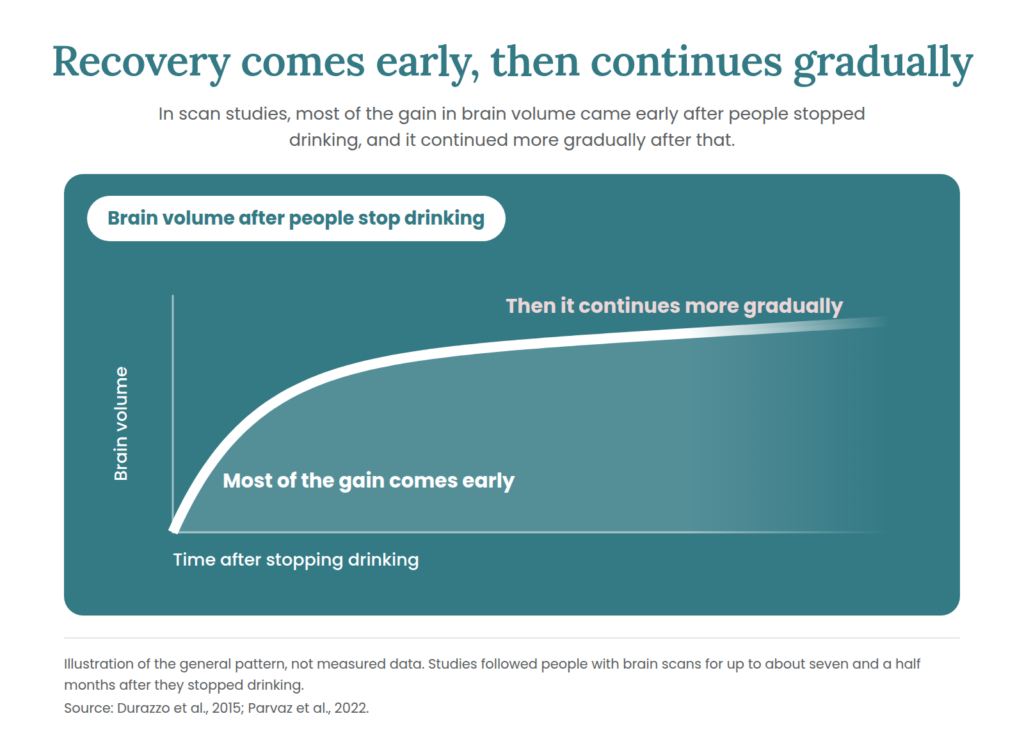
The biggest gains tend to come early, and recovery can keep going more gradually after that. There’s no single timeline, though. How quickly things improve varies from person to person and depends on which part of brain function you’re looking at, and starting sooner gives the brain more time to do this work.
Can the brain recover from alcohol?
Yes. When people stop drinking, the brain recovers in real, measurable ways, both in its structure and in how well it thinks and remembers.1 The recovery researchers have measured so far is partial and not complete, but the direction is clear: things get better. Studies that followed and scanned the same individuals over time found at least partial recovery after they stopped drinking.2
One reason that’s possible is neuroplasticity, which is the brain’s ability to adapt and rewire itself based on what you do.3 It’s the same ability that lets you learn a new skill, and it also plays a role in recovery after you stop drinking.
How long does it take, and will it go back to normal?
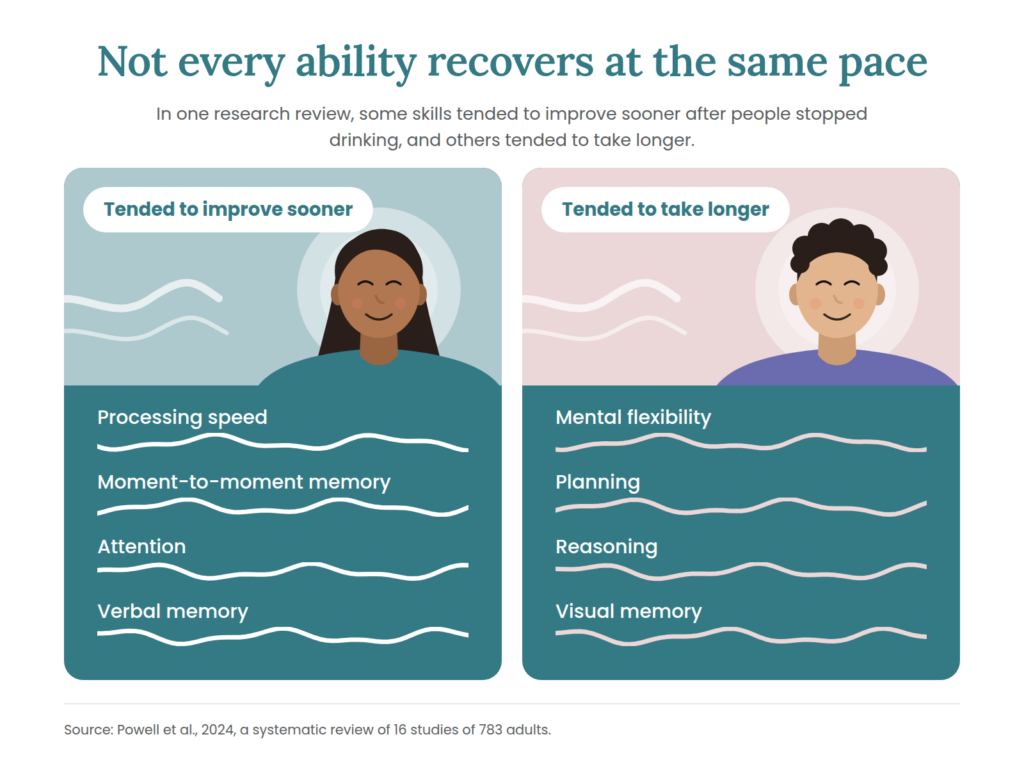
Recovery doesn’t happen on one set schedule, and different parts of the brain can recover at different rates. Most of the improvement comes early, and the brain’s thinking and memory abilities are much better within about a year.4
Brain scans show the same thing on the structural side. One of the main measures researchers use is brain volume, the amount of brain tissue a scan can pick up. Brain volume tends to be lower after heavy drinking, so seeing it increase after someone stops is one of the clearest signs the brain is physically recovering. Most of that gain in brain volume comes during the first month and then continues more gradually.2,5
Studies of thinking and memory tell a similar story. Many abilities returned to a normal range within six to twelve months, while some improved sooner and others took longer.4
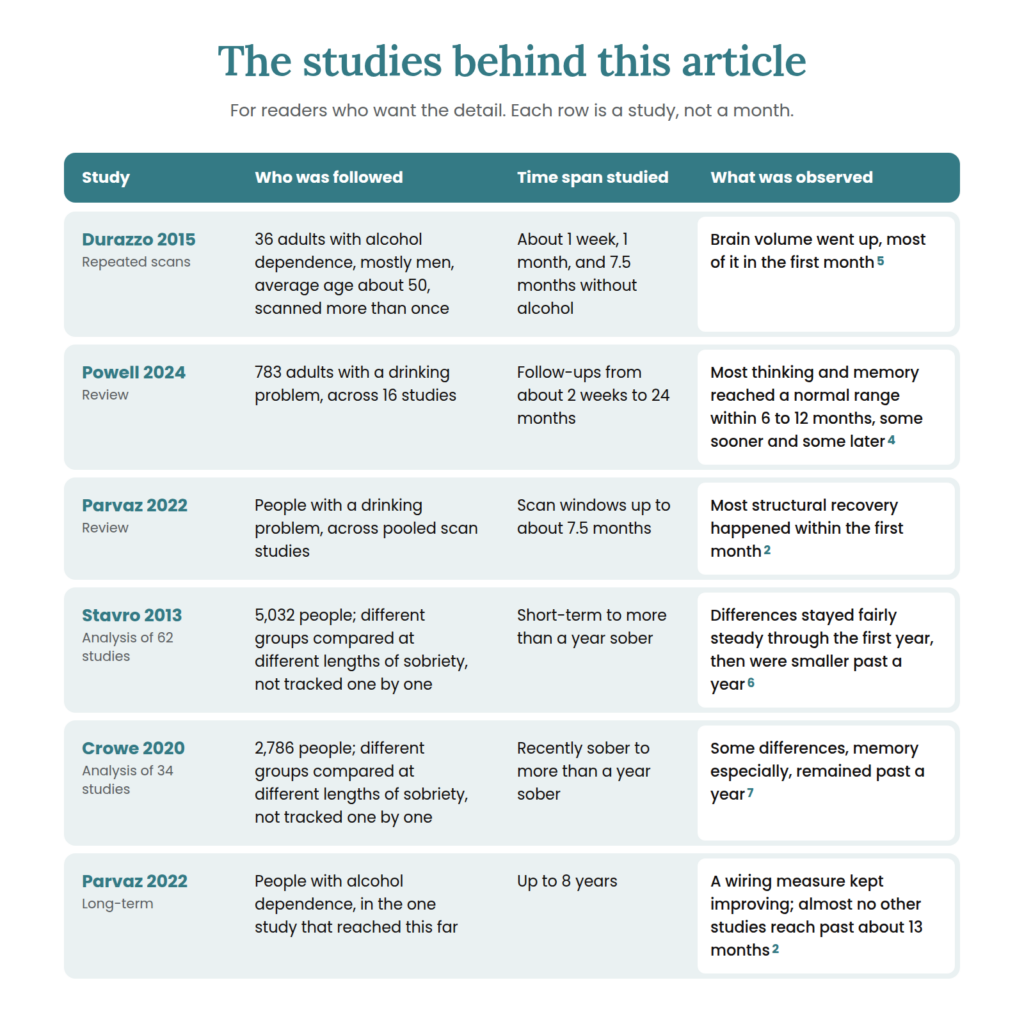
Most of what researchers know covers the first year, and it points the same way: real, measurable recovery. Past about a year, few studies have followed people long enough to say what happens next, so the far end is still being studied.2,6,7 That is a gap in the research, not a sign that recovery stops, and it is why the honest answer is a range rather than a fixed date.1
One more thing to keep in mind as you read the timelines below: these numbers describe groups of people in research studies over set periods. They’re not a countdown clock or a schedule for your own recovery. Your age, health, smoking history, drinking patterns, and other individual factors can all make your experience different.
Why your head feels foggy right now
If your head feels slow, foggy, or forgetful in the weeks after you stop or cut back, you’re not imagining it, and this is common.
Research found that attention, memory, planning, and other kinds of thinking can be affected in the studies of those individuals who had recently stopped drinking.4 Alcohol can also affect everyday things like motivation, decision-making, and impulse control.1
The encouraging part is that these same studies show the abilities that tend to come back first include processing speed (how quickly you take in and respond to information), moment-to-moment memory, and attention.4 There’s no date that fits everyone, but over time, the research points toward less brain fog and clearer thinking.
Recovery doesn’t always feel like steady progress
Brain recovery doesn’t follow one straight line. Some abilities can improve sooner than others, and you may go through stretches when it feels like nothing is changing.
So if you’re a few months in and don’t feel dramatically sharper than you did a few weeks ago, that alone doesn’t mean your recovery has stalled. Research looking at thinking and memory found that improvement wasn’t steady across the first year.6,7 Some parts of brain recovery simply take more time.4,5
What affects how fast you recover
The same studies looked at what may change recovery from one person to the next. The short version: individual differences have an effect on recovery, so your experience will not match any single chart.
The best-supported factors are age and smoking, and two separate lines of research agree. On the scan side, older people who smoked recovered less brain volume than non-smokers. More years of smoking also went with less recovery in the front of the brain’s wiring, the part that supports focus and planning.5 On the thinking side, smokers, and heavier lifetime smokers, started out worse and recovered more slowly, and older age went with slower recovery, too.4
How much and how long someone drank also matters, but it should not be oversold. In the scan study, there was a weak link between heavier drinking and less recovery in the front of the brain.5 Other medical, psychiatric, and substance-use conditions did not predict how much volume came back.5
These factors help explain why recovery looks different from person to person.
The first days are about safety
If you’re thinking about stopping or significantly cutting back on alcohol, there’s something important to know before thinking about the longer recovery timeline: for some people, alcohol withdrawal can be dangerous or even deadly.8
After heavier drinking, changes in the brain can make stopping or cutting back difficult without medical help. Withdrawal can also involve low mood, irritability, pain, and trouble sleeping.1 These symptoms are part of a medical condition that may need care, and they’re not a matter of willpower.
Before you cut back or stop
Talk with a clinician before stopping or sharply reducing alcohol, particularly if you’ve been drinking heavily.8
You can start that conversation with Eleanor Health. Our clinicians can talk with you about what’s been going on, assess what level of care you may need, and determine whether outpatient treatment is appropriate. If you need a higher level of care, we can help connect you with it and remain part of your care team. Eleanor is not an inpatient or residential detox facility.
If this is a medical emergency, call 911 or go to an emergency room.
For more on what the body goes through when drinking stops, see the stages of alcohol withdrawal.
What actually helps
You don’t have to “will” your brain to recover. What helps is having the kind of care that makes lasting change more manageable. No supplement, vitamin, special diet, or brain-training app can substitute for appropriate care.
Research supports two main approaches to treatment: FDA-approved medications and behavioral care, including therapy.1 Behavioral care can help calm the brain’s reward and stress systems and strengthen the networks that help you hold back the urge to drink, and together, medication and behavioral care can support the brain’s recovery.1 A review of neuroplasticity reaches a similar point: the brain’s own ability to adapt is part of what makes treatment work.3
Medication is one option a provider may consider, chosen and managed with a clinician. Effective, non-addicting options exist and are worth asking about. None of them repairs the brain on its own. For more, see medication for addiction treatment (MAT) for alcohol.
How Eleanor Health can help
If brain fog or worry about lasting damage is what brought you here, that’s a reasonable place to start a conversation about drinking. You don’t need to know what you want to do next before you reach out.
At Eleanor Health, we’ll start by listening to what’s been going on and helping you figure out what kind of support makes sense for you. Depending on where you live, care may be available virtually, in person, or through a combination of both.
Your care can include medication for addiction treatment (MAT); individual or group therapy with a licensed therapist; and psychiatric care for conditions such as depression or anxiety, which often travel alongside alcohol use. You can also work with a Community Recovery Partner, someone who brings their own lived experience of recovery to the support they provide. For more, see treatment for alcohol use disorder. Most insurance is accepted, and which services are available varies by location.
A return to drinking does not mean losing your care team. We do not discharge members for a setback; these moments are treated as part of many people’s recovery, not a reason to stop treatment.
This may describe someone you care about rather than you. Read more if you are worried about someone else’s drinking.
Frequently asked questions
How long does it take for the brain to recover after quitting alcohol?
There’s no single timeline, but research gives us some idea of what recovery can look like. In studies of thinking and memory, many abilities reached a normal range within six to twelve months.4 In brain scans, most of the volume gain happened in the first month.5 The long run is contested: one large analysis found most thinking problems ease by about a year, while a newer one found some, memory especially, still there past a year.6,7 All of it describes groups studied for set periods, not a schedule any one person can hold themselves to.
Is alcohol brain damage reversible?
The brain can recover from some of the changes associated with long-term alcohol use. Studies have documented measurable improvement in both brain structure and thinking after people stop drinking.1 Researchers haven’t established that every change fully reverses, but they also haven’t shown that differences remaining at the end of a study are necessarily permanent.5
Can the brain fully recover from alcohol?
There’s real reason for hope here. What research clearly shows is that the brain improves after someone stops drinking, in both its structure and in how well it thinks and remembers, and that improvement is well documented.1,2 What isn’t settled yet is the far end of the timeline: how complete that recovery becomes over many years, which few studies have followed people long enough to measure. A federal source puts it plainly: we don’t yet fully understand how much the brain can return toward normal after long-term sobriety.1 That is an open question in the research, not a limit on what’s possible for you, and the part within your control, stopping or cutting back and staying with evidence-based care, is exactly what the measured improvements were built on.
Does alcohol kill brain cells?
Alcohol can harm the brain and affect areas involved in memory, attention, decision-making, and impulse control.1 But studies of brain recovery don’t generally measure how many individual brain cells have been lost or regained. Instead, researchers measure things like brain-tissue volume and performance on tests of thinking and memory.5
Researchers also don’t yet fully understand what’s happening at the cellular level behind the changes seen on brain scans.5 So those scans can show us that the brain changes and recovers, but they can’t tell us that brain cells were “killed” and then grew back.5
Why do I still feel foggy weeks after I stopped drinking?
Feeling foggy in the early weeks can happen, and research shows that thinking and memory may take time to improve after someone stops drinking.4 There’s no exact timeline that applies to everyone. If you’re still struggling with memory, concentration, or clear thinking, it’s worth talking with a clinician about what you’re experiencing. Feeling foggy now doesn’t by itself tell you that your recovery has stalled.
Will supplements or vitamins help my brain recover?
Two different questions are worth separating here. As a way to boost brain recovery, the research this article draws on did not test supplements, vitamins, or special diets, so it gives no basis to recommend them for that purpose.
As part of medical care in early recovery, though, some do matter. Thiamine (vitamin B1) is a standard part of alcohol treatment because it helps prevent a serious and potentially permanent brain complication that can develop early after heavy drinking.9 Clinicians also check for and correct other nutritional deficiencies when they are present.9 Whether any of this applies to you is a question for your clinician, who can weigh your own health and nutritional needs.
Is it too late for me if I’m still drinking?
No. You don’t have to already be sober to start thinking about recovery or asking for help. The improvements described above were measured after people stopped or cut back on alcohol, which means the door doesn’t close because you are still drinking now.1,2 If you are not sure whether your drinking has become a problem, here is how to tell whether drinking has become a problem. And if you want a low-pressure place to look at your own drinking, the online drug and alcohol assessment is a short, private start.
References
- Koob, G. F., & White, A. (2025, May 8). Neuroscience: The brain in addiction and recovery. National Institute on Alcohol Abuse and Alcoholism Core Resource on Alcohol. Retrieved August 25, 2026, from https://www.niaaa.nih.gov/health-professionals-communities/core-resource-on-alcohol/neuroscience-brain-addiction-and-recovery
- Parvaz, M. A., Rabin, R. A., Adams, F., & Goldstein, R. Z. (2022). Structural and functional brain recovery in individuals with substance use disorders during abstinence: A review of longitudinal neuroimaging studies. Drug and Alcohol Dependence, 232, Article 109319. https://doi.org/10.1016/j.drugalcdep.2022.109319
- Seo, D., & Sinha, R. (2015). Neuroplasticity and predictors of alcohol recovery. Alcohol Research, 37(1), 143–152.
- Powell, A., Sumnall, H., Smith, J., Kuiper, R., & Montgomery, C. (2024). Recovery of neuropsychological function following abstinence from alcohol in adults diagnosed with an alcohol use disorder: Systematic review of longitudinal studies. PLOS ONE, 19(1), Article e0296043. https://doi.org/10.1371/journal.pone.0296043
- Durazzo, T. C., Mon, A., Gazdzinski, S., Yeh, P. H., & Meyerhoff, D. J. (2015). Serial longitudinal MRI data indicates non-linear regional gray matter volume recovery in abstinent alcohol dependent individuals. Addiction Biology, 20(5), 956–967. https://doi.org/10.1111/adb.12180
- Stavro, K., Pelletier, J., & Potvin, S. (2013). Widespread and sustained cognitive deficits in alcoholism: A meta-analysis. Addiction Biology, 18(2), 203–213. https://doi.org/10.1111/j.1369-1600.2011.00418.x
- Crowe, S. F., Cammisuli, D. M., & Stranks, E. K. (2020). Widespread cognitive deficits in alcoholism persistent following prolonged abstinence: An updated meta-analysis of studies that used standardised neuropsychological assessment tools. Archives of Clinical Neuropsychology, 35(1), 31–45. https://doi.org/10.1093/arclin/acy106
- Alcohol use disorder. (2025, April 19). MedlinePlus. National Library of Medicine. Retrieved September 3, 2026, from https://medlineplus.gov/ency/article/000944.htm
- Kattimani, S., & Bharadwaj, B. (2013). Clinical management of alcohol withdrawal: A systematic review. Industrial Psychiatry Journal, 22(2), 100–108. https://doi.org/10.4103/0972-6748.132914