Deciding to quit kratom is a real first step
If you have decided to stop using kratom, that decision took effort. It is easy to move past this first step quickly, diving straight into the practical questions about how and when. But deciding is often the hardest part, and you have already done it.
Recovery is often not a straight line. Plenty of people stop, start again, and stop once more, and a return to use does not erase the decision you made. Wherever you are in that process, this article covers what quitting kratom usually involves, why it can be difficult, and where to find support if you want it.
Quick Summary
- Deciding to stop using kratom is a real step. If you are reading this, you have already started.
- Quitting can be hard because dependence is physical, not a matter of willpower. Addiction is a treatable medical condition.
- Stopping suddenly on your own can be uncomfortable, and for some people it carries real risk. Talking to a clinician can help you understand what to expect and what level of support may be right for you.
- You do not have to do this alone. Treatment for kratom dependence exists, and it can start with a conversation about what quitting would look like for you.
Why do people decide to stop using kratom?
People stop for their own reasons, and those reasons make sense in their own lives. Some notice they are taking more than they used to, or taking it earlier in the day. Some are tired of the cost, or of planning around the next dose. Some want to feel more clear-headed, or want their relationships and their sleep back. Some started using kratom to manage pain or opioid withdrawal and later found they had become dependent on kratom.
None of these reasons is better than any other, and you do not need to reach a crisis point to decide you are ready to stop. Wanting more control over your own day is reason enough.
Why quitting kratom can be difficult
Quitting kratom is hard for a physical reason, not a character reason. Kratom’s main compounds act on the same receptors in the brain that opioid medications act on, called mu-opioid receptors.1 With regular use, the body adjusts to their presence, and stopping means the body has to readjust. That is what dependence is.2 It can happen to anyone who uses kratom regularly, whatever their reason for starting.
Tolerance is part of the same picture. Over time, the same amount may have less effect than it once did, and some people may find themselves taking more or using it more often. By the time someone notices, the body has already adapted, and stopping means undoing that adaptation.
This is why willpower is the wrong focus. The American Society of Addiction Medicine calls addiction “a treatable, chronic medical disease,” shaped by brain circuits, genetics, environment, and a person’s life experiences, and says treatment for it is generally as successful as treatment for other chronic diseases.3 If a previous attempt to quit did not stick, that is information about how dependence works, not about you.
What happens when you stop: a brief word on withdrawal
When someone who uses kratom regularly stops, they may go through withdrawal, and it can resemble opioid withdrawal.1,4 Symptoms and severity can vary from person to person, and research on kratom withdrawal is still developing.1,5
Withdrawal is one of the main reasons people find it hard to stop on their own, and it is also the part a clinician can help you plan for.4 For more on what kratom withdrawal involves, see Kratom Withdrawal: Symptoms, Timeline & Treatment Options
“We’re taking care of a fair number of people who have become addicted to kratom, and it is a very difficult withdrawal.”
— Nzinga Harrison, MD, Co-Founder and Chief Medical Officer, Eleanor Health
Preparing to quit kratom
Preparing to quit is less about a schedule and more about not doing it alone.
A useful first step is to talk with a clinician about what quitting may look like for you. Clinicians generally approach kratom withdrawal the way they approach opioid withdrawal, with ongoing support afterward to help people stay well.4 Having that conversation before your last dose means someone can look at your own history, your other medications, and how much and how long you have been using, and tell you what that means for you specifically.
The other half of preparing is lining up support before you need it, rather than assembling it on a hard day. That might be one person you trust who knows what you are doing and why, a peer support group, a clinician you can reach, or a care team that brings those together in one place. Eleanor Health is built that way: medication-assisted treatment (MAT), therapy, and peer support, from home, arranged around the life you already have. If you have used other substances alongside kratom, including concentrated products like 7-OH, say so when you talk to a clinician. It gives your clinician a fuller picture.
Why quitting alone can be hard, and when support helps
Stopping kratom suddenly can cause uncomfortable withdrawal symptoms, and the severity can vary depending on factors such as your health, other medications or substances you use, and how much and how long you have been using kratom.2 Discomfort is also part of why stopping does not always hold: it is why clinicians treating kratom withdrawal plan for ongoing support afterward, not just for the first hard days.4
Support can make the process more manageable. It doesn’t make the hard days disappear, but it means you are not the only one managing them.
If reaching out feels like an unusual step, you’re far from alone. Many people need support when changing their relationship with alcohol or other drugs. Asking for help does not mean you waited too long, and you do not have to prove that you tried to handle it on your own first.
When to get medical help for kratom withdrawal
Some situations call for medical support rather than a solo attempt, and reaching out in those moments is a sign of good judgment, not failure.
Consider contacting Eleanor Health if:
- You’ve tried to stop using kratom before but restarted because withdrawal symptoms felt overwhelming.
- Your withdrawal symptoms are making it difficult to sleep, work, or carry out daily activities.
- You’re using kratom daily or in large amounts and aren’t sure how to stop safely.
- You’re also using alcohol, opioids, benzodiazepines, or other substances.
- You have underlying physical or mental health conditions that could complicate withdrawal.
- You’re concerned about cravings or returning to opioid or other substance use.
Call 911 or seek emergency medical care immediately if you experience severe difficulty breathing, seizures, loss of consciousness, chest pain, or any other life-threatening symptoms.
For most people, Eleanor Health can help manage kratom withdrawal in an outpatient setting. Our clinicians can assess your symptoms, recommend the appropriate level of care, and help you develop a plan.
If you’re outside our service area, need immediate assistance, or aren’t sure where to turn, the SAMHSA National Helpline (1-800-662-HELP [4357]) is a free, confidential, 24/7 treatment referral and information service available in English and Spanish.6
What professional treatment for kratom can include
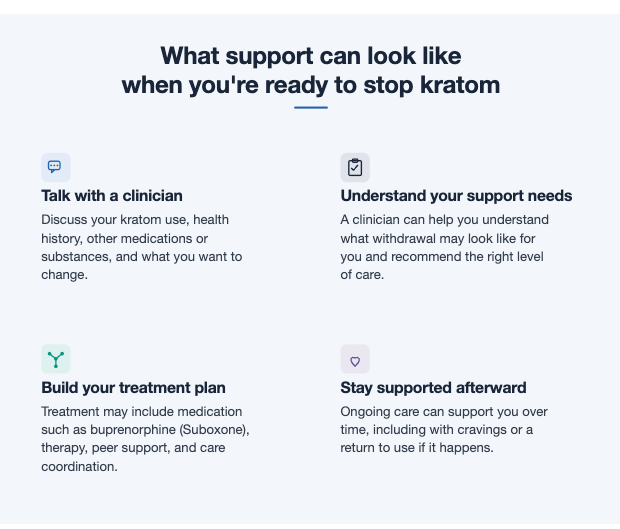
Treatment for kratom use can include medication, therapy, peer or community recovery support, and care coordination. In practice that tends to mean some combination of medication where it is appropriate, therapy, peer or community recovery support, and care coordination to keep those pieces connected.
Each piece does something different. Medication, when a clinician considers it a fit, can help with physical symptoms, so the early days are not harder than they need to be. Therapy is where the reasons behind the use get addressed, which helps with the emotional and behavioral aspects of recovery. Peer support puts you around people who have been through it and can share their experience and knowledge. Care coordination helps to keep appointments, prescriptions, and follow-up from falling through the cracks.
Medications such as buprenorphine (Suboxone) can help manage kratom withdrawal because kratom acts on opioid receptors and can produce similar withdrawal symptoms.7-9 At Eleanor Health, clinicians regularly use Suboxone to treat kratom withdrawal and kratom use disorder. The published evidence is still limited primarily to case reports and case series rather than large controlled trials, but clinical experience supports it as a treatment option. An Eleanor clinician can determine whether medication is appropriate based on your symptoms, health history, and individual needs.
For more on how medication for addiction treatment works, see Online Opioid Addiction Treatment: Signs, Causes, & Options
How Eleanor Health can help
If you decide you want support, Eleanor Health provides ongoing, whole-person care for substance use disorder, including medication for addiction treatment, therapy, and peer support. Virtual care is available in the states where Eleanor operates, with in-person visits available in some states. Care can happen from home, and most insurance is accepted; coverage and available services may vary by state.
Eleanor Health can assess and manage most kratom withdrawal through outpatient care, including medication, therapy, peer support, and care coordination. If your clinician determines that you need a higher level of care, we can help coordinate that care and remain part of your treatment team afterward.
Eleanor Health does not provide medically supervised detox. If you’re outside our service area or need immediate help finding treatment, the SAMHSA National Helpline at 1-800-662-4357 is free, confidential, and available 24/7.
To see what that looks like day to day, see Exploring Online Addiction Treatment Benefits & Advantages.
Taking the next step
There is no deadline here, and no right moment you have already missed. If you want to talk through what quitting kratom could look like for you, Eleanor Health is a place to start, and you can ask questions before committing to anything.
Deciding you want to make a change is already a meaningful step. You do not have to figure out the rest on your own.
Frequently asked questions
Is it safe to stop taking kratom suddenly?
Stopping kratom suddenly, sometimes called quitting cold turkey, can cause uncomfortable withdrawal symptoms, and severity varies from person to person.1 Your health, other medications or substances, and how much and how long you’ve been using kratom can all affect what withdrawal is like. Talking with a clinician can help you understand what to expect and what level of support may be appropriate. The safest approach is to talk to a clinician before you stop so you know what to expect in your own situation.
How do I stop taking kratom?
A good place to start is by talking with a clinician about your kratom use and what you want to change. Kratom withdrawal is generally managed the way opioid withdrawal is managed, with ongoing support afterward.4 From there, the practical parts are lining up support, picking a time that fits around your life, and knowing who you will call if it gets hard. There is no single schedule that fits everyone, which is why the clinician conversation comes first.
Why is it so hard to quit kratom?
Because dependence is physical. Kratom’s compounds act on the brain’s opioid receptors, and regular use leads the body to adjust.1 Addiction is a treatable, chronic medical condition, and treatment for it is generally as successful as treatment for other chronic diseases.3 Difficulty quitting is not a sign of failure or lack of willpower.
Can medication help me quit kratom?
Yes. Medications such as buprenorphine (Suboxone) can help manage kratom withdrawal and kratom use disorder. Eleanor clinicians regularly use Suboxone as a treatment option for people who use kratom. Published research is still limited primarily to case reports and case series, so your clinician will consider your symptoms, health history, and individual needs when recommending treatment.7-9
When should I get professional help to quit kratom?
Any time you want it. You don’t need to be in crisis, and you do not need to have tried and failed first. If you are unsure, a conversation with a clinician is a reasonable place to start.
Does Eleanor Health help people quit kratom?
Yes. Eleanor Health provides whole-person outpatient care for people who want help reducing or stopping kratom use. Our clinicians can assess your needs and may recommend medication, therapy, peer support, and care coordination. Most kratom withdrawal can be managed in outpatient care. If you need a higher level of care, Eleanor can help coordinate it and remain part of your care afterward. Services and coverage vary by state.
If you’re outside Eleanor’s service area or need immediate help finding treatment, the SAMHSA National Helpline at 1-800-662-4357 is available 24/7.
Sources
- National Institute on Drug Abuse. Kratom. NIDA. Updated March 11, 2026. Accessed July 23, 2026. https://nida.nih.gov/research-topics/kratom
- US Food and Drug Administration. FDA and kratom. FDA. Accessed July 23, 2026. https://www.fda.gov/news-events/public-health-focus/fda-and-kratom
- American Society of Addiction Medicine. Definition of addiction. ASAM. Adopted September 15, 2019. Accessed July 23, 2026. https://www.asam.org/quality-care/definition-of-addiction
- Stanciu CN, Gnanasegaram SA, Ahmed S, Penders T. Kratom withdrawal: a systematic review with case series. J Psychoactive Drugs. 2019;51(1):12-18. doi:10.1080/02791072.2018.1562133
- World Health Organization Expert Committee on Drug Dependence. Forty-fourth report. Geneva: World Health Organization; 2022. WHO Technical Report Series, No. 1038. https://www.who.int/publications/i/item/9789240042834
- Substance Abuse and Mental Health Services Administration. National helpline. SAMHSA. Accessed July 23, 2026. https://www.samhsa.gov/find-help/helplines/national-helpline
- Broyan VR, Brar JK, Allgaier T, Allgaier JT. Long-term buprenorphine treatment for kratom use disorder: a case series. Subst Abus. 2022;43(1):763-766. PMID 35112990. doi:10.1080/08897077.2021.2010250
- Buresh M. Treatment of kratom dependence with buprenorphine-naloxone maintenance. J Addict Med. 2018;12(6):481-483. PMID 29944481. doi:10.1097/ADM.0000000000000428
- Weiss S, Douglas H. Treatment of kratom withdrawal and dependence with buprenorphine/naloxone: a case series and systematic literature review. J Addict Med. 2021;15(2):167-172. PMID 32858563. doi:10.1097/ADM.0000000000000721