Quick Summary
“Functioning alcoholic” is an everyday phrase, not a medical diagnosis. People often use it to describe someone who drinks heavily or has problems related to alcohol while appearing to still keep up with work, family, and other responsibilities. But outward appearances don’t tell the whole story. What matters more is how alcohol is affecting your health, relationships, daily life, and ability to control your drinking.
What people mean by “functioning alcoholic”
When people say “functioning alcoholic,” they usually mean someone whose drinking concerns them even though much of life still looks intact. The job gets done, kids get picked up, bills get paid, and things haven’t visibly fallen apart.
That can make it easy to think, I don’t really have a problem. I’m still functioning. But “functioning” describes what other people can see. It doesn’t tell you how alcohol is affecting your health, mood, relationships, or sense of control.
In private, this can feel like being the reliable one, getting through a rough morning without anyone noticing, and trying to keep drinking in its own compartment away from everything else. If that sounds familiar, the phrase is describing something real about your life.
Why it isn’t a medical diagnosis
“Functioning alcoholic” isn’t a medical diagnosis. Alcohol use disorder (AUD) is a medical condition that clinicians diagnose when someone has a hard time stopping or controlling their drinking even when it is causing problems with health, work, or relationships.1 AUD can be mild, moderate, or severe.1,2
Someone can meet the criteria for AUD while still working, caring for a family, and managing other responsibilities. That’s why how well someone appears to be “functioning” isn’t a reliable way to determine whether they have AUD.
What the research actually found
One large national study of adults with alcohol use disorder shows that alcohol problems don’t always look the way people expect.1,3 In some groups in the study, drinking problems started later in life, most people worked full time, and many were doing well in other parts of their lives. But even among the group researchers described as the “highest functioning,” alcohol still posed significant health risks.3
The study doesn’t define a type of person called a “functioning alcoholic.” It simply reinforces an important point: someone can appear to be doing well and still experience meaningful harm from alcohol.
In real life, this can look like keeping up at work while drinking heavily most evenings, or getting the kids to school after a night of heavy drinking no one else knows about. It may look like someone has a handle on things from the outside, while managing the strain alcohol creates takes real effort.
If you recognize your experiences in these descriptions, that’s information, not a diagnosis. It doesn’t sort you into a category. It brings up a question that’s worth asking.
A better question than “Am I still functioning?”
“Still functioning” describes what other people can see. Going to work, paying the bills, caring for your family, and meeting your responsibilities are meaningful. But they only tell you part of the story.
Alcohol may be affecting things that aren’t as visible: your sleep, mood, health, relationships, or how much time and attention drinking occupies. You may have tried to cut back and found it harder than expected. Or you may need more alcohol than you once did to get the same effect. (Low mood and drinking often go together, and both can be hard to see from the outside.)
Keeping up with work and daily responsibilities can’t tell you everything.3 Alcohol may be playing a bigger role in your life than you’d like, or making it harder to feel well, do your best, or get along with the people close to you.
Instead of asking, “Am I still functioning?” a more useful question may be: “How is alcohol affecting my life?”
What tends to matter more
Alcohol use disorder is defined by how drinking is affecting your life, not how things look. It means continuing to drink even when it’s causing problems with health, work, or relationships.1 These consequences may happen privately, not publicly.
Keeping up with your responsibilities shows that you’ve been holding things together. It doesn’t show what holding things together may be costing you. A few questions can make this clearer: Whether alcohol is costing you something you care about. Whether cutting back has been harder than you expected it to be. Whether it takes more than it used to in order to feel the same.
Your answers to these questions can point to a pattern worth taking seriously. The signs that drinking has become a problem show the fuller picture of what clinicians look at.
Suggested structured content: “What functioning tells you” vs “What it doesn’t.” A two-column comparison for EH to stage rather than drafted as body copy. Left: you have been holding things together. Right, as questions, never a count or a score: whether alcohol is costing you something; whether cutting back has been hard; whether it takes more than it used to. This carries the whole argument of the page with nothing a reader could turn into a self-test. Do not build a signs checklist, a severity scale or spectrum graphic, a quiz, a before-and-after, or anything that sorts people into functioning and non-functioning.
| What “functioning” tells you | What it doesn’t tell you |
|---|---|
| You’ve been holding things together. You may still be managing work, family, and daily responsibilities. | Is alcohol costing you something? Has cutting back been hard? Does it take more alcohol than it used to? |
Four questions clinicians ask
Clinicians sometimes use four short questions, known as the CAGE questionnaire, to decide whether a longer conversation about drinking is worth having. The four below came out of a hospital study and were published in a medical journal as a brief screening tool.4
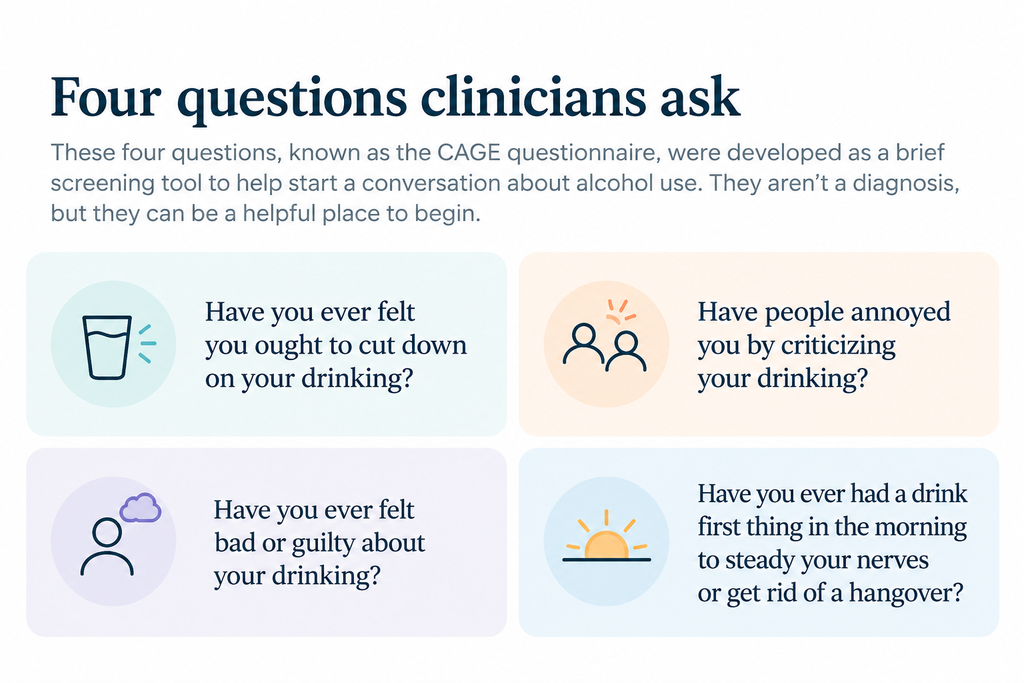
Note that a screening tool doesn’t equal a diagnosis; the paper that introduced these questions stated that a diagnosis shouldn’t rest on a questionnaire alone.4 What the questions do is open a conversation. Even one “yes” is worth talking through with a clinician, along with anything else you’ve noticed.4
What drinking guidelines say, and what they don’t
The current federal guidelines don’t set a daily drink limit. The Dietary Guidelines for Americans, 2025–2030, advise drinking less for better health and say some people shouldn’t drink at all, including people in recovery from alcohol use disorder.5
The National Institute on Alcohol Abuse and Alcoholism (NIAAA) does describe two drinking patterns that carry more risk. Heavy drinking means five or more drinks on any day, or 15 or more a week, for men; for women, four or more on any day, or eight or more a week. Binge drinking means about five drinks for men, or four for women, within about two hours. Over time, both raise the chance of developing alcohol use disorder.1
These patterns describe risk, not a diagnosis. Alcohol use disorder is about losing control over drinking even when it’s causing problems, and that can happen with or without heavy or binge drinking.1
How common is this?
If you’re wondering about your drinking, you’re far from alone. In 2025, about 25.0 million US adults, 9.4% or nearly 1 in 10, met the criteria for alcohol use disorder in the past year.6 Drinking itself is even more common: in 2025, about half of US adults, 48.1%, had a drink in the past month.6
If you’re wondering about someone else
You may be here about someone else rather than yourself. The same idea applies to them: whether a friend or loved one is still functioning tells you very little about what alcohol may be costing them.
It’s common, and reasonable, to notice things about the people close to you. It doesn’t mean you’re judging them, and you don’t have to be certain of anything to look for support. Here’s a place to start if you’re worried about someone else’s drinking.
What a next step actually looks like
If any of this sounds familiar, a good next step is to talk it through with a clinician. You don’t have to have decided anything, be certain, or stop drinking first. You and your clinician can work out what comes next together.
Eleanor Health treats alcohol use disorder as the medical condition it is, with care built around the whole person: medication for addiction treatment, therapy with a licensed therapist, psychiatry for conditions such as depression or anxiety that often travel alongside drinking, and support from a Community Recovery Partner, someone with their own lived experience of recovery. For the full picture, see treatment for alcohol use disorder. Which services are available varies by location.
Stopping altogether isn’t the only starting point. For some people the first move is reducing alcohol use; you can explore what cutting back with support looks like.
Most insurance is accepted. And a return to drinking does not mean losing your care team: Eleanor does not discharge members for a setback, because those moments can be part of many people’s recovery rather than a reason to stop treatment.
This is not about willpower, and it never was. Whenever you want to start the conversation, you can get the support you need.
Frequently asked questions
What’s the difference between a “functioning” and a “non-functioning” alcoholic?
The difference people are pointing at is how much disruption is visible, not how serious the drinking is. Neither phrase is a diagnosis. Alcohol use disorder ranges from mild to severe, and it does that whether or not anything has visibly fallen apart.1
Is “high functioning alcoholic” a real medical term?
No. The clinical term is alcohol use disorder. Researchers have used “functional” to describe one group in a study of drinking patterns, but that’s a research label for a group in a dataset, not a diagnosis anyone receives.3
Can you have alcohol use disorder and still hold a job?
Yes. In one large national study of adults with alcohol use disorder, most people whose drinking problems began later in life were working full time.1,3
How can you tell if someone is a “functioning alcoholic”?
From the outside, usually you can’t, and that’s the whole point of the phrase. There is no list of signs that decides it, and searching for any signs tends to turn into watching them rather than supporting them. If you’re worried about someone, Eleanor’s guide for loved ones is a good place to start.
Do I have to stop drinking before I talk to someone?
No. Nobody has to be abstinent, certain, or ready to commit to anything before a first conversation. That’s what the conversation is for.
If I don’t drink much, am I fine?
Not necessarily. The current federal guidelines don’t set a daily limit; they advise drinking less for better health.5 Any amount of drinking carries some risk, and the risk rises with the amount.1 Alcohol use disorder isn’t defined by a number of drinks; it’s about losing control over drinking despite the problems it causes.1
What happens in an assessment?
It’s a private conversation about how drinking fits into your life, what you want to be different, and what options exist. You’ll be asked about your drinking and your health, then you and your clinician work out what makes sense from there.
References
- National Institute on Alcohol Abuse and Alcoholism. Understanding alcohol drinking patterns. NIAAA. Updated January 2026. Accessed October 20, 2026. https://www.niaaa.nih.gov/alcohols-effects-health/alcohol-drinking-patterns
- National Institute on Alcohol Abuse and Alcoholism. Understanding alcohol use disorder. NIAAA. Updated January 2025. Accessed October 20, 2026. https://www.niaaa.nih.gov/publications/brochures-and-fact-sheets/understanding-alcohol-use-disorder
- Moss HB, Chen CM, Yi HY. Subtypes of alcohol dependence in a nationally representative sample. Drug Alcohol Depend. 2007;91(2-3):149-158. doi:10.1016/j.drugalcdep.2007.05.016
- Ewing JA. Detecting alcoholism: the CAGE questionnaire. JAMA. 1984;252(14):1905-1907. doi:10.1001/jama.1984.03350140051025
- US Department of Agriculture; US Department of Health and Human Services. Dietary Guidelines for Americans, 2025–2030. Published January 7, 2026. Accessed October 20, 2026. https://cdn.realfood.gov/DGA.pdf
- Substance Abuse and Mental Health Services Administration. Results from the 2025 National Survey on Drug Use and Health: Detailed Tables. Center for Behavioral Health Statistics and Quality; 2026. Published July 27, 2026. Accessed October 20, 2026. https://www.samhsa.gov/data/report/2025-nsduh-detailed-tables