
In almost twenty years of practicing addiction medicine, I’ve learned that the moments that matter most in someone’s recovery are often the ordinary ones. The quiet questions people carry into a first appointment. Among the most common is, “If something changes, will I be able to keep going without starting over?”
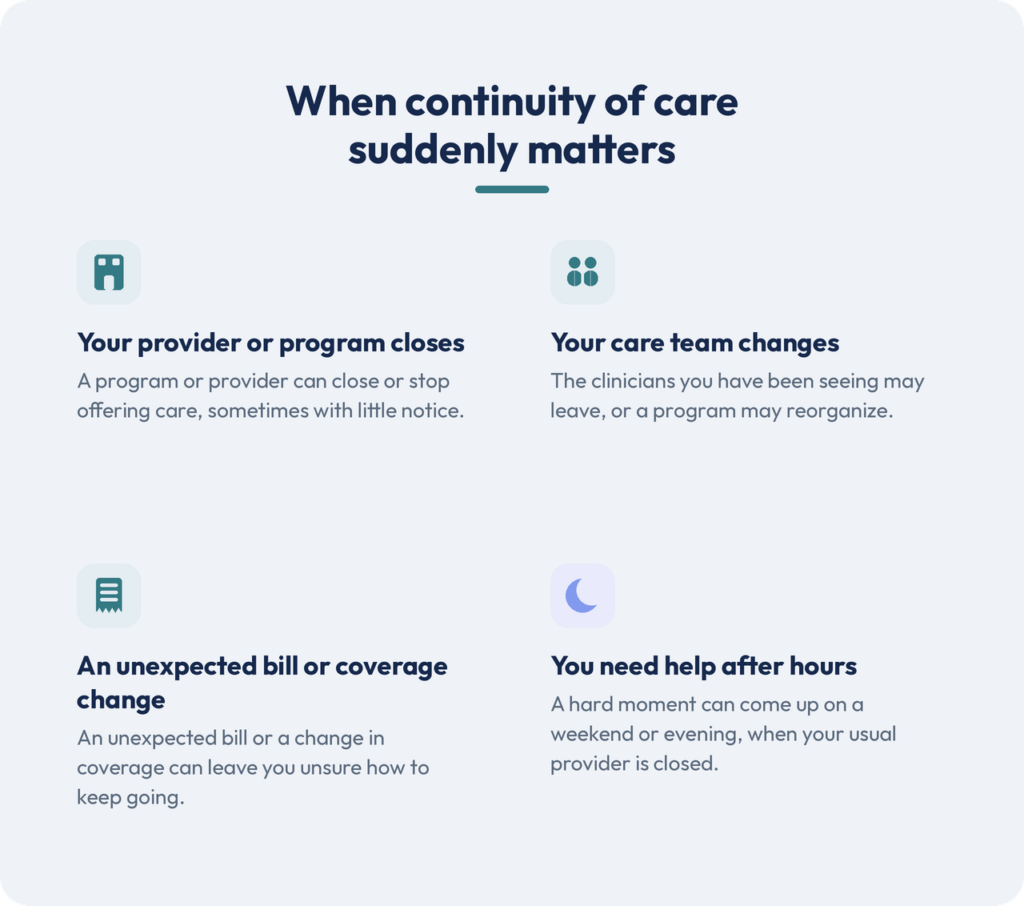
Care can change. Insurance shifts. People move to a new city or state. A provider may become unavailable, or a program may change how it works. And life gets busy or complicated in the way life does. Any of these can interrupt the care someone has been relying on, and that interruption tends to arrive at an inconvenient time. I want to talk about what continuity of care actually means when that happens and what you should be able to expect.
Your history should come with you
When someone starts care with us in the middle of their recovery, my first goal is to understand what’s already working. What medication are you taking? What routines are holding you steady? Which relationships and supports matter to you? Recovery is built over time, and that work belongs to you. It shouldn’t have to be rebuilt from scratch because circumstances changed.
This is why I think of joining a new care team as a handoff, rather than a restart. A handoff means we pick up where you are, with what you’ve already accomplished treated as the foundation. You shouldn’t have to prove yourself again or start the story over from the beginning. At Eleanor, we design care around that continuity on purpose, because protecting the progress you’ve made is part of the treatment.
The cost nobody sees coming
Here’s something I’ve watched happen too many times in twenty years: someone finds care that’s working, then an unexpected bill arrives. Suddenly, they’re trying to make sense of what their insurance covers, what they owe, and whether they can afford to keep going.
More than 8 in 10 people with a substance use disorder never get treatment in a given year, according to SAMHSA. Cost confusion is a big part of why. Surprise bills. Coverage nobody translated into plain English. A benefits letter that raises more questions than it answers. That uncertainty lands on someone who’s already carrying more than enough.
At Eleanor, we try to make the cost clear from the beginning. We verify your insurance before your first visit, at no cost to you. If something isn’t covered, we work to make sure you understand that before the service happens. Knowing what to expect financially can make it easier to focus your energy on your care.
Support that lasts between visits
Recovery does not happen only during appointments. The harder moments often show up in the spaces in between, on a weekend or late at night, when the next visit still feels far away. Connection is what carries people through those stretches, and connection is central to how we approach care.
That means building a relationship with a care team that knows your story, so that when you reach out you are talking with people who already understand where you are. Feeling known, and knowing there is somewhere to turn is one of the most important parts of staying well.
A setback does not end your care
Another fear people bring to a first appointment is some version of this question: “If I have a setback, will I lose my care?” It’s one of the most important things I want people to hear clearly, so I’ll say it plainly. At Eleanor, a return to use does not automatically end your care.
A drug screen is information. It helps us understand what you need next, and it guides the conversation about how to adjust your support. Recovery rarely moves in a straight line, and the moments when things get hard are exactly the moments when staying connected to care matters most. When that happens, staying connected helps us understand what you need next and how your care can adapt.
Care that can move with you
What ties all of this together is a simple idea. Your care should be able to adapt as your life and your needs change, without asking you to give up the ground you’ve gained. Continuity is not only about staying with the same team. It’s about making sure that whatever changes around you, the thread of your care holds.
If your addiction treatment care has been interrupted, or you are looking for support that can meet you where you are, we’re here. You don’t have to start over.