




By Nzinga Harrison, MD Chief Medical Officer & Co-Founder, Eleanor Health
Dry January tends to show up right after one of the busiest, loudest, most social times of the year: the holidays. Parties. End-of-year stress. A lot of late nights and “just one more” moments.
So when January hits and people say, “I think I’ll take a break from drinking,” my advice is simple: don’t overthink it. This isn’t a lifetime commitment. It’s not even a promise to go a full month. It’s just… trying something different.
As I like to say, it’s the Nike approach: just do it.
If Dry January feels overwhelming, that’s not a failure. It’s information.
A lot of people start the month thinking, How am I going to get through an entire month without drinking? Then another thought sneaks in: Why does this feel so hard?
That moment is worth paying attention to.
Alcohol often plays a bigger role in our stress management, routines, and social lives than we realize. If the idea of not drinking for a few weeks feels impossible, it may be pointing to how much alcohol has become a coping tool.
That’s not something to judge or feel ashamed about. It’s something to get curious about.
Here’s a simple way to think about cravings.
If you eat breakfast every day at 8 a.m. and suddenly skip it, your body doesn’t politely wait. You get ravenous — not because something is wrong, but because your body expected food at a certain time.
Alcohol can work the same way.
If you usually have a drink after work or before dinner, your brain and body may have built that into your routine. When you stop, your system notices. Mentally and physiologically, your body says, Hey, where’s the thing we usually get right now?
That’s why cravings happen. And that’s why they don’t mean you’re weak or doing something wrong.
One of the most practical tools we share is the acronym HALT:
These are the moments when cravings tend to hit hardest. For many people, that’s right after work — before dinner — when stress is high and energy is low.
Planning ahead helps. Eat regularly so you don’t get overly hungry. Make time for connection, even without alcohol. Protect your sleep as much as you can. And give yourself something else to look forward to during that familiar “drink o’clock” window.
This part really matters.
When people shame themselves for cravings or slip-ups, it often increases the very feelings that drive drinking. Shame increases loneliness. Self-criticism increases anger. Stress goes up, not down.
So instead of thinking, What’s wrong with me? try thinking, What is this teaching me?
Cravings are data. They can help you understand the role alcohol plays in your life — and whether you might benefit from more support.
For many people, having something in their hand helps. The good news is the non-alcoholic world has gotten really good.
Non-alcoholic beers and sparkling wines. Zero-proof cocktails. Alcohol-free spirits. Adaptogen-based “mood” drinks.
You can absolutely have a delicious Bloody Mary, a sparkly drink, or a fancy cocktail moment — without the consequences of alcohol.
And for some people, movement, time outdoors, sunlight, or leaning into a hobby can feel just as rewarding.
People often ask what to expect physically during Dry January.
If you’re a light or occasional drinker, the first week is usually pretty smooth.
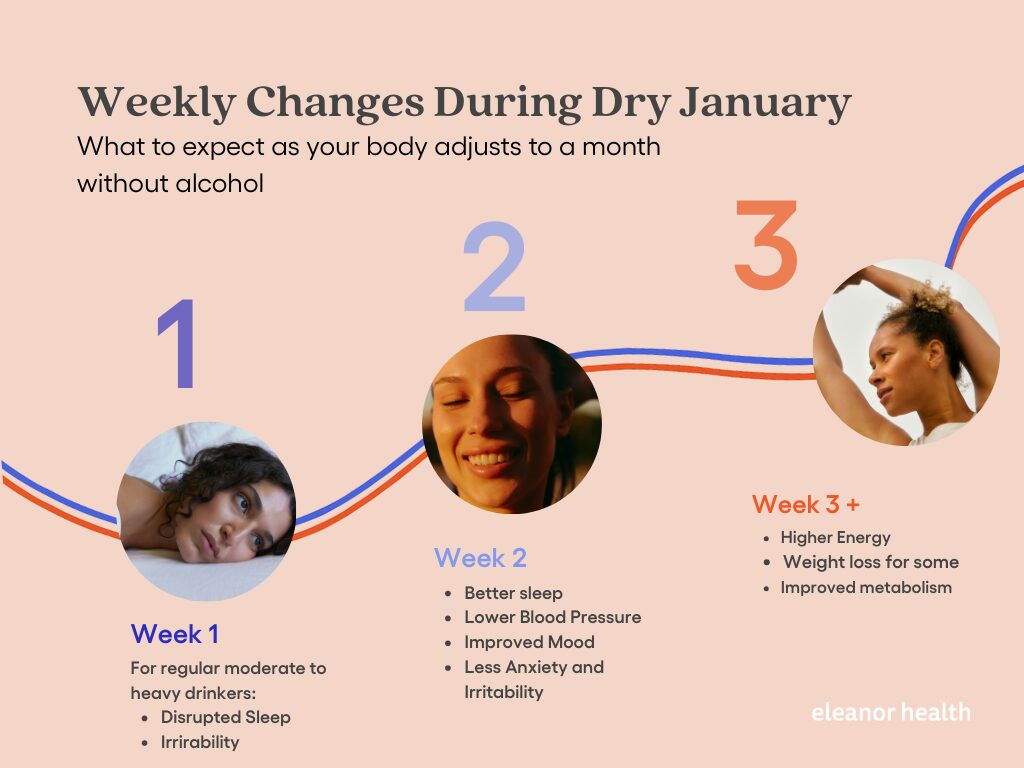
If you’re a regular moderate-to-heavy drinker, the first week can feel worse before it feels better. Sleep may be disrupted at first. Irritability can show up. That’s your body recalibrating.
It’s worth noting that while alcohol can feel relaxing at first, research shows it disrupts REM sleep and can lead to more nighttime awakenings later in the night. This helps explain why sleep often improves after a few weeks without alcohol.
By the second week, many people notice real improvements, including:
Studies have shown that reducing or stopping alcohol can lead to measurable improvements in blood pressure and heart rate within weeks.
By week three, people often say they feel surprisingly… new.
Weight changes can happen too. A standard alcoholic drink contains roughly 100–150 calories — sometimes comparable to half a slice of cake. When you remove that daily intake, many people notice changes in energy, weight, and overall metabolism.
This is important.
If you drink heavily and regularly, stopping alcohol cold turkey can be dangerous. Alcohol withdrawal can be serious and even life-threatening.
If you experience symptoms like shaking, sweating, severe anxiety, or sensations like bugs crawling on your skin, that’s an emergency. Go to the ER.
If you’re drinking more than four drinks per day on a regular basis, talk with your primary care provider before stopping. You can still do Dry January, but it may need to involve a gradual reduction rather than stopping all at once.
There’s a persistent myth that alcohol use disorder only affects people who have “hit rock bottom.” In reality, that stereotype represents a small fraction of people.
Alcohol use disorder exists on a spectrum, from mild to severe. Many people with alcohol use disorder are working, raising families, and showing up every day. What defines it isn’t appearance — it’s whether alcohol causes negative consequences and whether drinking continues despite them.
In fact, nearly 29 million people in the U.S. meet criteria for alcohol use disorder, many of whom are employed and socially connected.
Dry January doesn’t have to lead to abstinence forever. Maybe it leads to drinking less. Maybe it leads to asking better questions. Maybe it leads to more support.
All of those are valid outcomes.
Like any behavior change, it’s easier with support.
That’s why we go to the gym with friends, binge shows together, or text someone when motivation dips. If you’re doing Dry January, consider doing it with a buddy — someone who can say, “Come on, you’ve got this,” on the day you don’t feel like it.
Because change is hard. And none of us are meant to do it alone.
If Dry January is bringing up cravings or concerns, you don’t have to figure it out alone. Learn more about Alcohol Use Disorder (AUD) and what support can look like.