
Getting help for alcohol use looks different than it used to. What once meant driving to a clinic, taking time off work, or arranging childcare can now happen from your couch. But with the ease of telehealth comes a question that might be holding you back: Is my information really private when I’m getting addiction treatment online?
Is Telehealth Alcohol Treatment Private?
It’s a fair question. The good news is that your privacy is protected by multiple layers of federal law and secure technology—often more protected than you might think. In many cases, virtual treatment offers the same, or stronger, privacy protections as in-person care. Here’s what you need to know about how telehealth alcohol treatment works and how your information stays confidential.
How Telehealth Alcohol Treatment Actually Works
Telehealth alcohol treatment means you connect with your care team through secure video. It’s like Zoom or FaceTime, but with medical-grade privacy protections. You can meet with doctors, counselors, and peer support specialists from wherever you feel comfortable talking openly.
What does treatment look like? At Eleanor Health, we combine medication addiction treatment to help with cravings and withdrawal, one-on-one counseling to work through what’s driving your drinking, and peer support from people who get what you’re going through. All of this happens through video calls that are encrypted and protected by the same privacy laws that cover any medical appointment.
The only difference is where you are when it happens. You can join an appointment during your lunch break, early in the morning before anyone’s awake, or after work, without explaining to anyone where you’re going. That flexibility alone removes a lot of the obstacles that keep people from getting help.
How HIPAA Protects Telehealth Alcohol Treatment
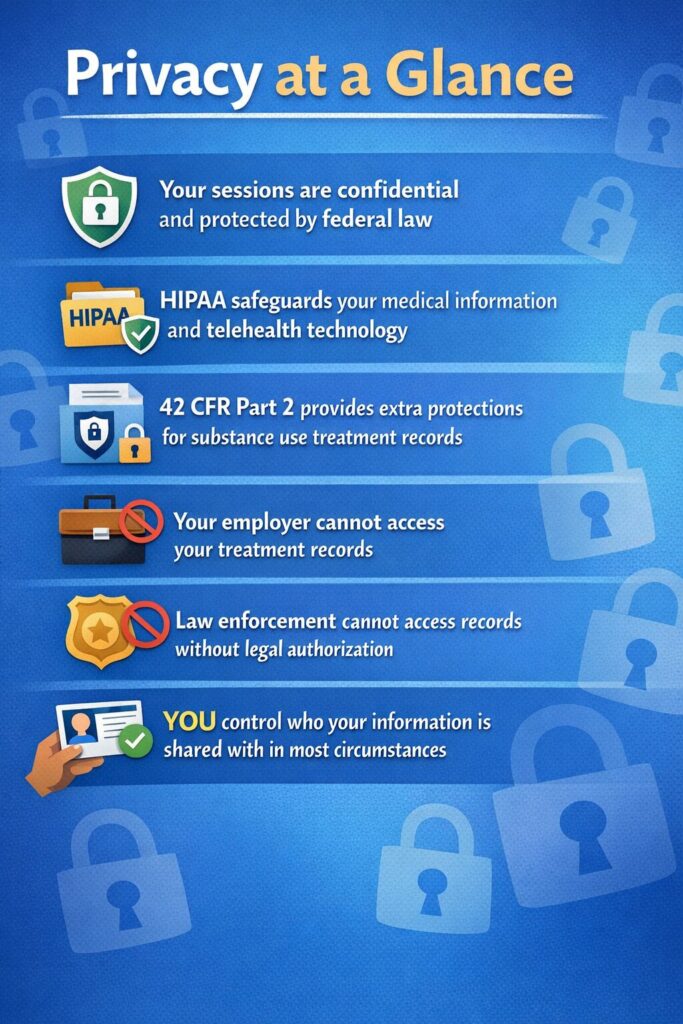
HIPAA (the Health Insurance Portability and Accountability Act) applies to telehealth just as it does to in-person care. Under HIPAA:
- Telehealth platforms must use secure, encrypted technology
- Access to your records is limited to authorized healthcare professionals
- Providers must take reasonable steps to ensure privacy during appointments
- Your information cannot be shared without permission except as allowed by law
HIPAA focuses on both technology and behavior, ensuring your care is private, whether it happens in an office or over video.
The U.S. Department of Health and Human Services requires that telehealth platforms use encrypted video, secure passwords, and protected networks so no one can intercept or access your information without authorization.
But HIPAA isn’t just about technology. Your provider should be in a private space during your appointments and let you know if anyone else is in the room with them. They should also encourage you to find a private spot for your sessions. These steps help make sure that even though you’re talking over video, your conversation stays between you and your care team.
Additional Protections Under 42 CFR Part 2
Here’s where alcohol and drug treatment gets even more protection than other medical care.
In general, 42 CFR Part 2 means:
- Your substance use treatment records cannot be shared without your written consent
- Disclosure is limited to specific situations required by law
- Information shared for care coordination must follow strict rules
- Records are generally protected from use in legal proceedings, with limited exceptions
The protections are designed to help you seek treatment without fear that your information will be widely disclosed or misused.
This was created specifically to protect people seeking substance use treatment. It exists because lawmakers recognized that the fear of stigma or legal consequences keeps people from getting help.
According to SAMHSA, this law means your substance use treatment records cannot be shared without your written consent, except in limited circumstances permitted by law. . Even when you do give permission, there are limits on how that information can be used.
The rules have been updated recently to make things easier. You can sign one consent form that covers ongoing treatment, rather than signing a new form every time your care team needs to coordinate with someone. But the core protection stays the same: you’re in control of who knows about your treatment.
And here’s something important: your treatment records are generally protected from disclosure and use in legal proceedings, with limited exceptions defined by federal law. That protection exists so you can get help without worrying about legal consequences down the road.
What Eleanor Health Does to Keep Your Information Safe
We take the legal requirements seriously, but we also add our own safeguards on top of what the law requires. Our video platform uses end-to-end encryption, which means your sessions are protected from anyone trying to intercept them.
Everyone on our team, from doctors to counselors to peer support specialists, is trained on privacy laws and understands why confidentiality matters. When you connect for an appointment, we verify it’s actually you, and we conduct sessions in private settings.
Your medical records live on secure servers with strict controls over who can access them. Only the people directly involved in your expanded care options can see your information. We also keep logs of who looks at your records and when, which adds accountability and helps us spot any unusual activity.
When it comes to prescriptions, medications like naltrexone, acamprosate, or disulfiram are commonly used to treat alcohol use disorder and can be prescribed as part of a comprehensive treatment plan. We send them securely to whatever pharmacy you choose. You pick up your medication just like any other prescription, with the same privacy you’d expect.
How You Can Protect Your Own Privacy
Eleanor Health and other providers put a lot of security in place, but there are things you can do on your end to keep your treatment private:
Find a private space if you can. We know this isn’t always possible, but if you can take your appointment in a room where you won’t be overheard, that’s ideal. If you’re in a less private spot, headphones can help, and sitting away from other people makes a difference.
Use a secure internet connection. Your home Wi-Fi or your phone’s data is safer than public Wi-Fi at a coffee shop or library. When you’re talking about personal health information, a trusted connection matters.
Keep your device locked down. Update your phone, tablet, or computer regularly, and use a strong password or fingerprint lock. This prevents someone from accessing your device and seeing your appointment history or messages.
Privacy Questions About Telehealth Alcohol Treatment
Will My Employer Find Out I’m in Alcohol Treatment??
No, not unless you tell them. Your employer can’t access your treatment records without your written permission. You can schedule appointments during personal time, and there’s no requirement to explain to your boss that you’re getting care. If you use insurance, your plan may issue billing notices like EOBs that can include limited information about services billed. Who receives those notices depends on the plan and who the policyholder is. If you have concerns about privacy, you can contact your insurer to ask how EOBs are delivered and what options exist to keep communications confidential.
Can Law Enforcement Access My Records?
No. Your substance use treatment records are protected by 42 CFR Part 2, which means police can’t get them without your consent or a court order. They can’t just request them and get access.
What Happens If There’s a Data Breach?
Providers are required by law to tell you if your health information is breached. Eleanor Health uses multiple security layers to prevent this like encryption, regular audits, and strict access controls. If a breach occurs, Eleanor Health will notify you immediately and work to minimize impact.
What if someone in my house sees me on a video call?
You can say you have a medical appointment or personal call without giving details. Some people schedule appointments when others are out, or they just use a locked door. You don’t owe anyone an explanation about your healthcare.
The Bottom Line on Privacy and Getting Help
Understanding how your privacy is protected can help you feel more confident about reaching out. Millions of Americans meet the criteria for alcohol use disorder, according to the National Institute on Alcohol Abuse and Alcoholism, but many never get treatment. Privacy concerns are one of the reasons people don’t seek help, but they don’t have to be.
Telehealth brings together effective care with real privacy. Federal laws protect your information, secure technology keeps it safe, and you have control over your own privacy too. All of those pieces work together to keep your treatment confidential.
At Eleanor Health, we believe you should be able to get help without giving up your privacy. Our online program combines medication-assisted treatment, counseling, and peer support, all from wherever you feel comfortable. We’re available across 15 states, so quality care is accessible no matter where you are.
If you’re worried about your drinking, don’t let privacy concerns stop you from reaching out. The protections exist, the technology works, and getting help can change your life. Your decision to seek treatment is yours alone, and it’s protected every step of the way.
Ready to Take the Next Step?
You don’t have to figure this out alone. Eleanor Health offers confidential, judgment-free alcohol treatment that fits into your life. Connect with our team from home, work with providers who understand what you’re going through, and get the support you need, all while your privacy stays protected.
Call us to get started or schedule your free consultation online.
Citations
“Alcohol Treatment in the United States | National Institute on Alcohol Abuse and Alcoholism (NIAAA).” Nih.gov, 2024, www.niaaa.nih.gov/alcohols-effects-health/alcohol-topics-z/alcohol-facts-and-statistics/alcohol-treatment-united-states.
Office for Civil Rights. “Fact Sheet 42 CFR Part 2 Final Rule.” Www.hhs.gov, 7 Feb. 2024, www.hhs.gov/hipaa/for-professionals/regulatory-initiatives/fact-sheet-42-cfr-part-2-final-rule/index.html.
Telehealth.HHS.gov. “HIPAA for Telehealth Technology | Telehealth.HHS.gov.” Telehealth.hhs.gov, 6 Nov. 2023, telehealth.hhs.gov/providers/telehealth-policy/hipaa-for-telehealth-technology.
This content is for informational purposes only and does not replace professional medical or legal advice. Treatment decisions should always be made with a qualified healthcare provider.