Quick Summary
- Alcohol is a sedative. It may get you to sleep faster, but that is not the same as sleeping well.
- As alcohol clears your system in the second half of the night, the quality of your sleep starts to break down.
- Feeling like you need a drink to fall asleep is important information, not a character flaw, and it is worth talking to someone about.
Why does alcohol make you fall asleep?
Alcohol is a sedative, which means it slows activity in the brain and makes you feel sleepy.1 It quiets the parts of the brain you use to think and stay alert.2
That is why a drink before bed feels like it helps. It has a real, noticeable effect.
But feeling sleepy and sleeping well are two different things. In a study that measured both, people believed alcohol got them to sleep faster, while the measurement showed no real change.2
Why alcohol wrecks the second half of your night
Alcohol’s sedative effect fades after a few hours.1 The sleep that follows is choppy and restless.1
How does that work? As alcohol clears your body, the sedative effect does not simply wear off; it reverses. You become more wakeful in response.3
Alcohol flips this. Early in the night, while blood alcohol is still elevated, it suppresses REM sleep and boosts deep sleep, so you spend longer than normal in that very deep, hard-to-wake-from stage.1 Later, as your body metabolizes the alcohol and levels drop, deep sleep falls off while wakefulness and lighter sleep increase, leading to broken, restless sleep.1
That middle of the night wake-up, where you’re suddenly and completely awake but don’t know why? It’s not random, and you’re not a “bad sleeper.” It’s what alcohol does on its way out.
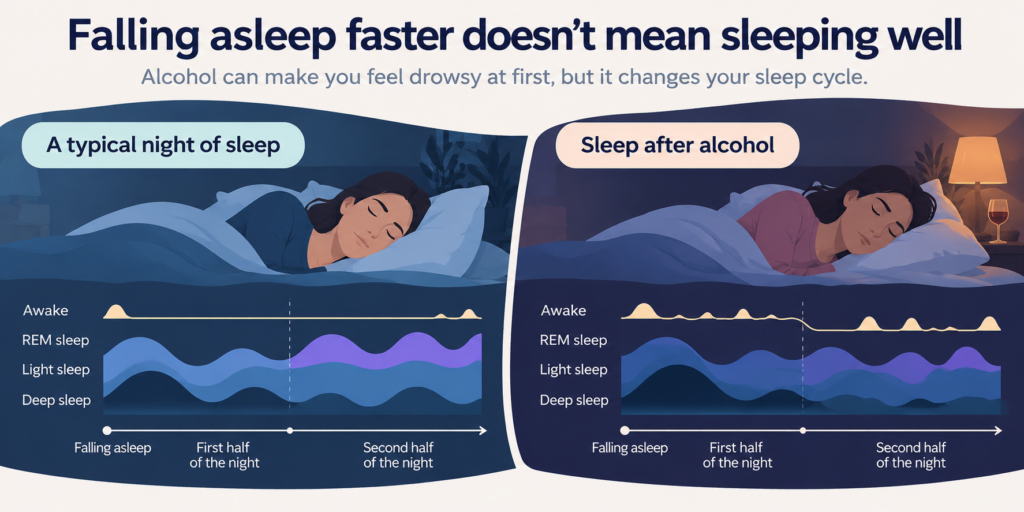
What alcohol does to REM and deep sleep and why it matters
REM sleep, short for rapid eye movement sleep, is the stage where most dreaming happens. Alcohol pushes REM sleep later into the night and reduces how much of it you get.1,2
Why does that matter? REM sleep stimulates areas of the brain involved in learning and memory, and it’s also the stage when dreaming typically occurs. Disrupted sleep can leave you feeling less refreshed and make it harder to concentrate the next day.4
It also takes less alcohol to do this than most people expect. The most recent systematic review of studies in healthy adults found that REM sleep was disrupted after about two standard drinks, and that disruption worsened as the amount went up.2
The same review found that the effects people actually want, falling asleep faster and dropping into deep sleep sooner, showed up only at much larger amounts, around five standard drinks.2
This research was done in healthy adults, so the findings may not carry over to people with a sleep disorder or an alcohol use disorder.2 Where your own sleep starts to suffer may differ.
Why it stops working: tolerance and the sedative effect
If the nightcap used to work and doesn’t anymore, there’s a reason.
Tolerance means your body adapts to a substance, so the same amount does less than it used to. With alcohol and sleep, the adaptation is uneven: alcohol loses its effectiveness as a sleep aid while keeping its sleep-disturbing effects.3 A small amount before bedtime may help you fall asleep at first, but that effect fades with continued use.3
Disturbed sleep later in the night doesn’t fade with it.3
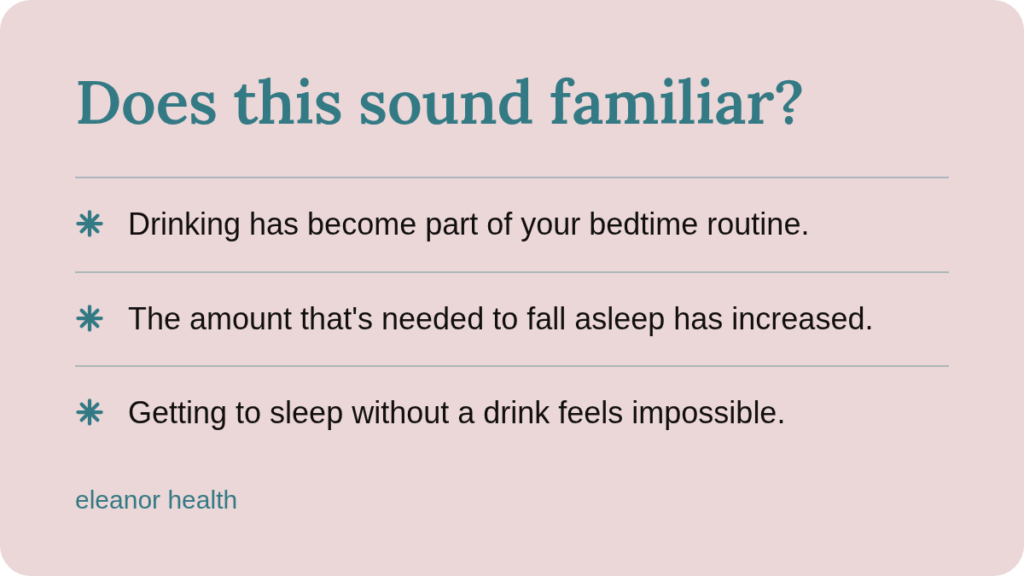
That trade-off is what makes a drink before bed harder to step away from. Sleep gets worse, so the drink can feel more necessary, and the amount needed creeps up. Researchers describe it as a loop: poor sleep drives more drinking, and more drinking further disturbs sleep.3
While the effect is well-documented, how fast this happens varies from person to person.
Does alcohol cause insomnia?
Alcohol disrupts sleep; that much is well established.1 Whether it causes insomnia is a harder question, because the relationship runs both ways.
Most of the research looks at people at a single point in time, which can show that the two go together but not which one came first.3 What the research does support: in low to moderate amounts, alcohol promotes sleep at first, and continued use disrupts the physical processes behind sleep, including in people who do not have an alcohol use disorder.3
The other direction is supported too. Trouble sleeping is itself a risk factor for later developing depression, anxiety, and problems with alcohol.1 For many people, the sleep problem came first, and drinking became a solution to it.
What it means if you can’t sleep without a drink
If you can’t fall asleep without a drink, you’re describing something clinicians see often.
Sleep research shows that using alcohol as a sleep aid is common.3 It’s a recognized pattern, not a personal failing. When someone reports a sleep problem, clinicians are advised to ask carefully about alcohol use.3 That isn’t a judgment; it’s part of understanding what’s affecting your sleep.
People who report symptoms of insomnia often don’t think of themselves as having insomnia.3 Noticing the pattern is more important than the label.
For the broader question, see how to tell whether drinking has become a problem. You can also take a short online drug and alcohol assessment.
Which drinks are the worst for sleep?
How much you drink, and how close to bedtime, matter far more than whether it’s beer, wine, or spirits.2,3
The amount matters, based on strong evidence. Sleep disruption starts at low amounts and gets worse as the amount rises.2 Timing matters, too. Drinking several hours before bed, as early as happy hour, can still disrupt sleep, even though the alcohol has left your brain by bedtime.3
Beverage type isn’t what this research measures. These studies measure alcohol by amount; the type of drink varied across them and wasn’t accounted for.2
Sleep when you cut back or stop
Sleep often gets worse before it gets better when someone cuts back or stops drinking.3,5 That’s documented, it’s common, and it doesn’t mean you’ve done anything wrong.
Sleep problems show up during active drinking, during withdrawal, and during abstinence; insomnia can persist after someone has stopped.3,5 People may not be warned about this, and not knowing is what can make it frightening.
There’s a clinical reason this matters. Disturbed sleep in early recovery has been linked to a return to drinking, even after accounting for depression and level of alcohol use.1,3,5 Vivid dreams and insomnia are also common during abstinence.1
So poor sleep after stopping is a reason to talk to a clinician, to decrease the chance it drives you back to drinking. Sleep problems can persist and are worth monitoring closely.3
There are non-medication approaches to insomnia, including cognitive behavioral therapy for insomnia (CBT-I).5
Before you cut back
Stopping or sharply reducing alcohol can be medically dangerous for some people, so it is worth talking to a clinician before you make a change.6
Eleanor Health can be your first call for that conversation. Our clinicians can assess where you are, determine the right level of care, and manage many people in an outpatient setting when that is clinically appropriate. If you need a higher level of care, we can help coordinate it and stay part of your team. Eleanor is not an inpatient or residential detox facility.
You can also reach the SAMHSA National Helpline at 1-800-662-4357. It is free, confidential, and open 24 hours a day, 365 days a year, in English and Spanish.7
If you are having a medical emergency, call 911 or go to an emergency room.
For more on what happens in the body when drinking stops, see the stages of alcohol withdrawal.
How Eleanor Health can help
If sleep is the reason you started reading this, that’s a perfectly reasonable place to start a conversation about drinking. You don’t need to make any decisions ahead of that.
Eleanor Health provides whole-person care for alcohol use disorder, delivered virtually, in person, or as a blend of the two, depending on where you live. That care includes medication for addiction treatment (MAT), therapy, a collaborative, non-judgmental space with a licensed therapist, offered in individual, group, or family formats; psychiatric medications for co-occurring conditions such as depression or anxiety, which often travel alongside alcohol use; and support from a Community Recovery Partner, someone with their own lived experience of recovery. See what working with a therapist actually looks like.
For more on the care itself, see treatment for alcohol use disorder and medication for addiction treatment for alcohol. Most insurance is accepted, and availability of specific services varies by location.
A relapse doesn’t mean losing your care team. We do not discharge members for a setback; these moments can be part of many people’s recovery journeys. They’re treated as information about your experience, not as a reason to stop treatment.
This may describe a friend or loved one rather than you. Read more if you’re worried about someone else’s drinking.
Frequently asked questions
Why can’t I sleep after drinking? The wake-up comes as your body finishes clearing the alcohol: the sedative effect reverses, and wakefulness rises in its place.3 That is why it happens during the second half of the night and feels so abrupt.2
Does alcohol actually help you fall asleep? It makes you feel like it helps, and at higher amounts it does shorten the time it takes to fall asleep.2 The sedation is real while better sleep is not.
Which drinks are the worst for sleep? The research doesn’t rank one type against another; the amount is what’s connected with sleep disruption.2 Compare by standard drinks rather than by glasses: 12 ounces of regular beer (about 5% alcohol), 5 ounces of wine (about 12%), or 1.5 ounces of distilled spirits (80-proof) each count as one standard drink.8
Is it a problem if I can’t sleep without a drink? It’s worth paying attention to, but it isn’t a diagnosis. Using alcohol to fall asleep is a recognized pattern that clinicians routinely ask about, so it’s a reasonable question to raise.3 If you want to look at the question more directly, the online drug and alcohol assessment is a low-commitment place to start.
Can I take melatonin or a sleep aid instead? This one is worth a conversation with a clinician. Substituting one sleep aid for another doesn’t address why sleep is broken, and some options interact with alcohol in ways that matter. For more on the interaction risk, see mixing alcohol with sedatives or sleep medication.
Will my sleep get better if I stop drinking? Often, yes, but it may get worse before it improves. Sleep disturbance is common during early abstinence.3,5 Sleep problems can persist even after several months without alcohol.1 This is something to track with a clinician rather than measure against a calendar. Do not stop abruptly on your own; talk to someone first.6
Does treatment for drinking help with sleep? Treatment for alcohol use disorder addresses the drinking, the mental health conditions that often sit alongside it, and the daily-life pieces that are part of the pattern. Sleep is usually part of that conversation rather than a separate focus.
References
- Colrain, I. M., Nicholas, C. L., & Baker, F. C. (2014). Alcohol and the sleeping brain. Handbook of Clinical Neurology, 125, 415–431. https://doi.org/10.1016/B978-0-444-62619-6.00024-0
- Gardiner, C., Weakley, J., Burke, L. M., et al. (2025). The effect of alcohol on subsequent sleep in healthy adults: A systematic review and meta-analysis. Sleep Medicine Reviews, 80, Article 102030. https://doi.org/10.1016/j.smrv.2024.102030
- Stein, M. D., & Friedmann, P. D. (2005). Disturbed sleep and its relationship to alcohol use. Substance Abuse, 26(1), 1–13. https://doi.org/10.1300/j465v26n01_01
- National Heart, Lung, and Blood Institute. (2011). Your guide to healthy sleep (NIH Publication No. 11-5271). National Institutes of Health. https://www.nhlbi.nih.gov/files/docs/public/sleep/healthy_sleep.pdf
- Brooks, A. T., & Wallen, G. R. (2014). Sleep disturbances in individuals with alcohol-related disorders: A review of cognitive-behavioral therapy for insomnia (CBT-I) and associated non-pharmacological therapies. Substance Abuse: Research and Treatment, 8, 55–62. https://doi.org/10.4137/SART.S18446
- National Library of Medicine. (2025, April 19). Alcohol use disorder. MedlinePlus. https://medlineplus.gov/ency/article/000944.htm
- Substance Abuse and Mental Health Services Administration. (n.d.). National Helpline. Retrieved August 25, 2026, from https://www.samhsa.gov/find-help/helplines/national-helpline
- Centers for Disease Control and Prevention. (2024, December 12). About standard drink sizes. https://www.cdc.gov/alcohol/standard-drink-sizes/index.html